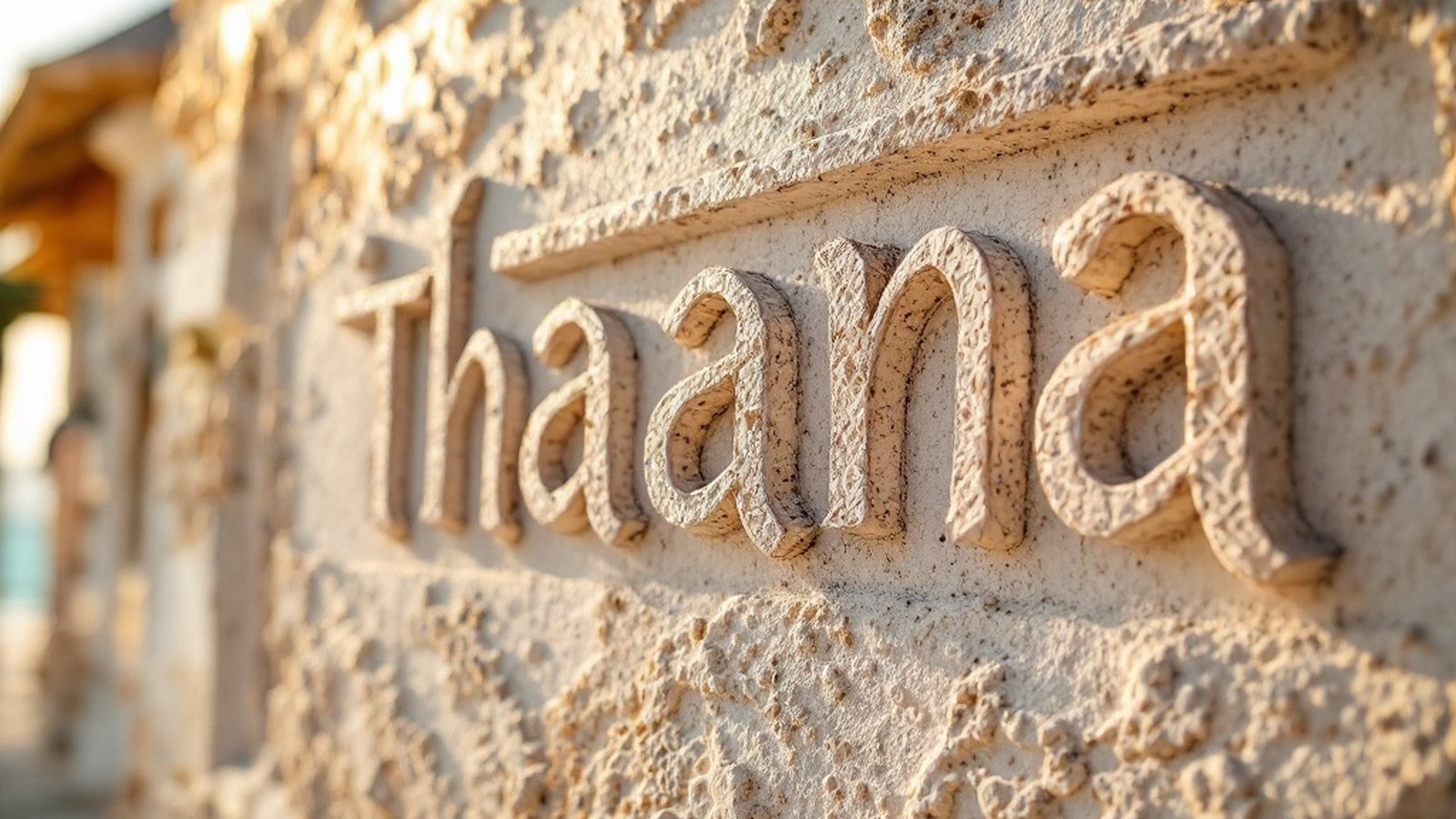
Where the Letters Come From
Dhivehi, the language of the Maldivian people, is written in a script called Thaana. At first glance it looks broadly familiar to anyone who knows Arabic: the letters flow from right to left, and small vowel diacritics — marks placed above or below the consonants — indicate the vowel sounds that sit between them. The Arabic debt is real and runs deep, a legacy of the archipelago's conversion to Sunni Islam in the twelfth century.
But look more carefully and something rarer appears. The earliest letters of the Thaana alphabet were not derived from an existing alphabet at all — they were adapted from Indic numeral forms, the number symbols inherited from South Asian traditions that had reached the Maldives long before Islam arrived. That combination, RTL Arabic organisation married to letterforms rooted in Indic numerals, is found in no other major script in the world. Thaana is genuinely singular.
What that singularity signals is a geography. The Maldives sits at the meeting point of two great spheres of influence — the Islamic world spreading across the Arabian Sea and the older Indic civilisations of South Asia. Centuries of trade, migration, and cultural exchange left their mark on everything: on the coral-stone mosques, on the cuisine, on the oral traditions. Thaana is simply the most precise and lasting record of that layered inheritance, compressed into twenty-four letters.
A Script That Survived Its Own Replacement
Thaana's resilience was tested in the 1970s, when the Maldivian government launched a Romanisation project — an attempt to shift written Dhivehi into the Latin alphabet. The experiment was brief. Maldivians did not adopt it, and the government eventually abandoned the effort. Thaana survived intact.
What the Romanisation drive left behind, curiously, was the name itself. Before the 1970s, the script was known simply as Tana in everyday use. During the standardisation work that accompanied the Romanisation project, the spelling Thaana emerged and was formalised. When the Latin-alphabet experiment was dropped, the new spelling stayed. A script that came out of a Romanisation attempt with nothing changed but its own name is, by any measure, a resilient piece of culture.
The alphabet that emerged standardised has twenty-four letters. It is written right to left, as Arabic is, but it reads as distinctly Dhivehi — the phonology it represents, the sounds it captures, belong entirely to the Maldivian language and not to Arabic or any Indic tongue.

- Pre-1970sscript known as Tana in everyday use
- 1970sMaldivian government launches Romanisation project; spelling Thaana formalised
- Post-1970sRomanisation abandoned; Thaana retained and standardised under new spelling
Reading the Maldives Through Its Script
You will encounter Thaana everywhere on an inhabited island: on shop fronts, mosque facades, government notices, the spines of school notebooks. Resort islands tend to run on English and Arabic, but step onto any local island and the script is present and alive. At Hukuru Miskiy — the Old Friday Mosque in Malé, built in the seventeenth century from finely cut coral stone — Thaana inscriptions run across panels and tombstones, each letter carved with the same precision given to the mosque's geometric lacquerwork and arabesque patterns. Those inscriptions are among the finest examples of coral-stone carving in the archipelago, and they are written, of course, in Thaana.
The National Museum of the Maldives in Malé holds royal documents and historical records in the script, alongside the regalia and artefacts of the old sultanate. Seeing Thaana in that context — not as a curiosity but as the formal written language of a sovereign state across many centuries — changes how you read the letters on the street outside.
Visitors do not need to learn Thaana to travel the Maldives. But knowing even the outlines of its origins — the Indic numerals folded into the earliest letterforms, the Arabic direction and diacritics, the brief Romanisation experiment that left only a name behind — gives you something useful: a way of seeing the islands that is not available through the resort brochure. The Maldives is one of the oldest continuously inhabited places in the Indian Ocean. Its script is one of the clearest proofs of that depth.