Reading the Islands
Step off the speedboat onto any inhabited island and Thaana is waiting for you: on the harbourmaster's notice board, on shopfront shutters painted in two colours, on the laminated menu propped against the tea-house counter. The script runs right to left, its letters looping and angular in equal measure, stacked with small vowel diacritics that sit above and below the consonant spine like musical notation. To an untrained eye it reads as pure pattern. Spend a few days and the shapes start to resolve into something almost familiar — the letters of Thaana were partly shaped by Arabic and Indic numeral traditions, and you can occasionally feel both tugging at a single letterform.
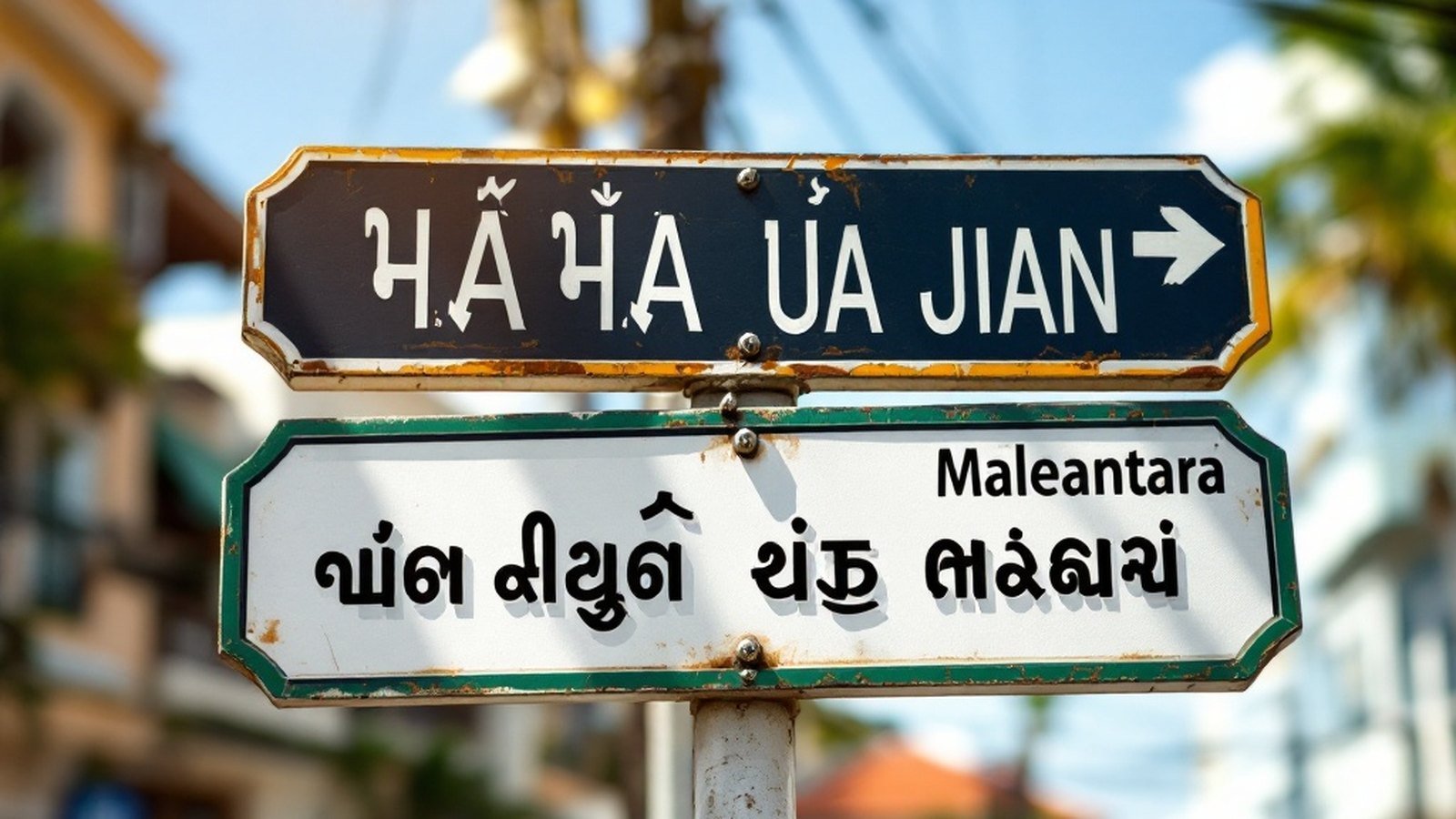
In Malé, Thaana works overtime. Street signs are bilingual — Dhivehi above, a romanisation below — but the Thaana line always sits in the dominant position, larger and bolder. Government ministry buildings carry their names carved or cast in both scripts, yet it is the Thaana version that faces the street at eye level. The National Museum labels its most precious exhibits in Dhivehi first. Even the Hukuru Miskiy, the seventeenth-century coral-stone mosque whose own interior walls carry Arabic calligraphy, is identified at its entrance gate in Thaana.
On screens, the script has made a confident transition to digital life. Smartphones sold across the archipelago ship with Dhivehi keyboard layouts, and local news platforms publish entirely in Thaana — a reader scrolls right to left through headlines about the tide forecasts, the price of skipjack tuna at the fish market, the schedules of Friday prayers. Social-media captions switch fluidly between Thaana and Latin script mid-sentence, a kind of bilingual shorthand the younger generation navigates without thinking.
Cloth is perhaps the most intimate surface. Mas libaas — the traditional women's dress — is sometimes woven or printed with Thaana phrases along the border, the letters functioning as ornament and meaning simultaneously. Sarongs sold in the craft stalls near Sultan's Park occasionally carry single words in Thaana script: blessings, place names, the names of atolls. Tourists buy them for the geometry; locals read what they say.
The script is not a relic kept behind museum glass. It is the live, working alphabet of a living language — painted, typed, embroidered and carved into the daily texture of the Maldives, visible on every island that people actually call home.