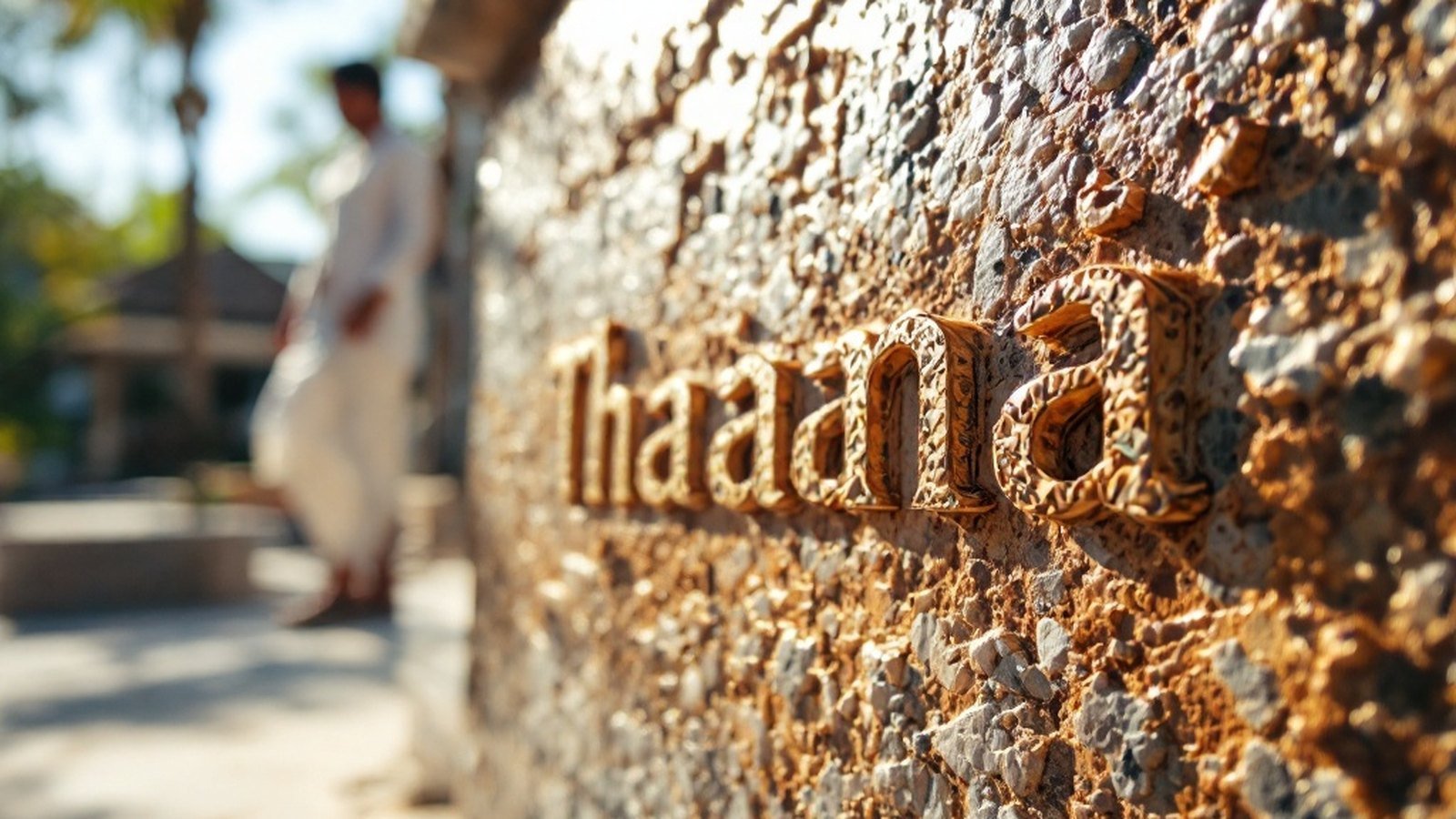
A script built from scratch
Pick up any Dhivehi newspaper and your eye lands on the wrong edge. Thaana runs right to left, like Arabic, but that's where the family resemblance ends. Unlike every other South Asian script — and unlike Arabic itself — Thaana was not borrowed wholesale from a neighbouring tradition. The Maldivians essentially built it themselves, pulling letterforms from Arabic numerals, from older Indic numerals, and from a now-extinct local script called Dives Akuru, then shaping them into something that belongs to no one else on earth.
The result is an alphabet of thirty-eight consonants, each one a compact, slightly abstract shape that rewards a few minutes of patient study. Vowels don't get letters of their own. Instead, they appear as small marks — vowel diacritics — written above or below the consonant they follow, much as in Arabic and other abjad-family scripts. Consonants without a following vowel carry their own diacritic too, a neat horizontal stroke that tells the reader to stop there and move on. Once you grasp that logic, the system clicks into place with satisfying economy.
Reading direction shapes the whole visual culture of Dhivehi. Books open from what an English reader would call the back. Headlines anchor to the right margin. On road signs in Malé, Thaana sits above or beside its Romanisation — the Latin-alphabet version required for tourism — and the two lines pull in opposite directions, a small daily reminder that the islands have always absorbed outside contact on their own terms.
Thaana is also an RTL script that never developed a cursive manuscript tradition the way Arabic did. Letters remain essentially separate, though in digital fonts they sit close enough to read as a flowing line. That separateness makes Thaana visually crisp on screen, which partly explains why Dhivehi social media and messaging culture has taken to it so naturally — the script translates well to a phone keyboard without the ligature complexity that makes Arabic typography technically demanding.
For the visiting reader, mastering Thaana is not the work of an afternoon. But learning to recognise it — its right-to-left river, its consonant blocks, the tiny diacritics clustering above and below — is the work of one. And that recognition changes something. The shop signs in island harbours, the inscriptions carved into the coral walls of Hukuru Miskiy, the captions in a local magazine: they stop being decorative pattern and start being language. The Maldives, it turns out, has always had a great deal to say.