The Mat Beneath Everything
Before the resort era, before concrete replaced coral, nearly every Maldivian home was furnished with thundu kunaa — fine mats woven from the dried leaves of the screwpine (Pandanus sp.), split into slivers as thin as ribbon and dyed in bold geometric arrangements. They covered the floor for prayer, lined the undoli swing seat for afternoon rest, dressed the ceremonial spaces where marriages were contracted and the dead were laid out. The mat was not décor; it was the surface of daily life.
The craft is associated above all with Gaafu Dhaalu Atoll in the south — particularly the island of Gadhdhoo — where the tradition survived long after it faded on other atolls. Elsewhere in the Maldivian archipelago, the skills thinned across the twentieth century as imported textiles and plastic matting arrived by dhoni. In these southern communities, women kept weaving.
Reading the Pattern
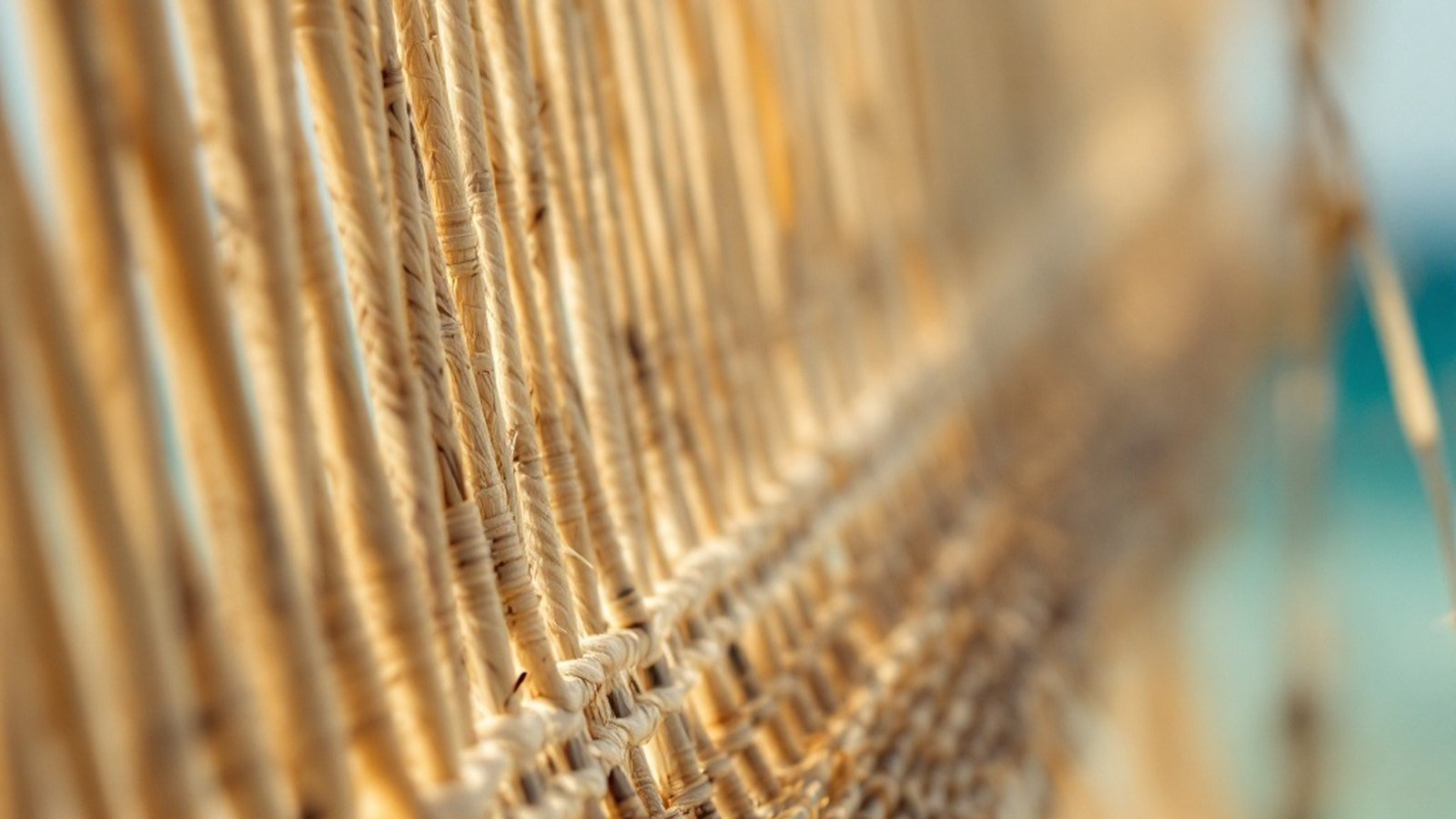
What distinguishes thundu kunaa from plain utility matting is the patterning woven into the structure itself — not printed on top, but built in, warp and weft simultaneously carrying colour and meaning. The geometric motifs have names: some represent ocean waves, others the forms of reef creatures or the angular vocabulary of Thaana calligraphy abstracted into line. No written pattern book exists; the designs live in the hands and memory of the weaver, passed from mother to daughter through demonstration and repetition — a form of oral tradition rendered in fibre.
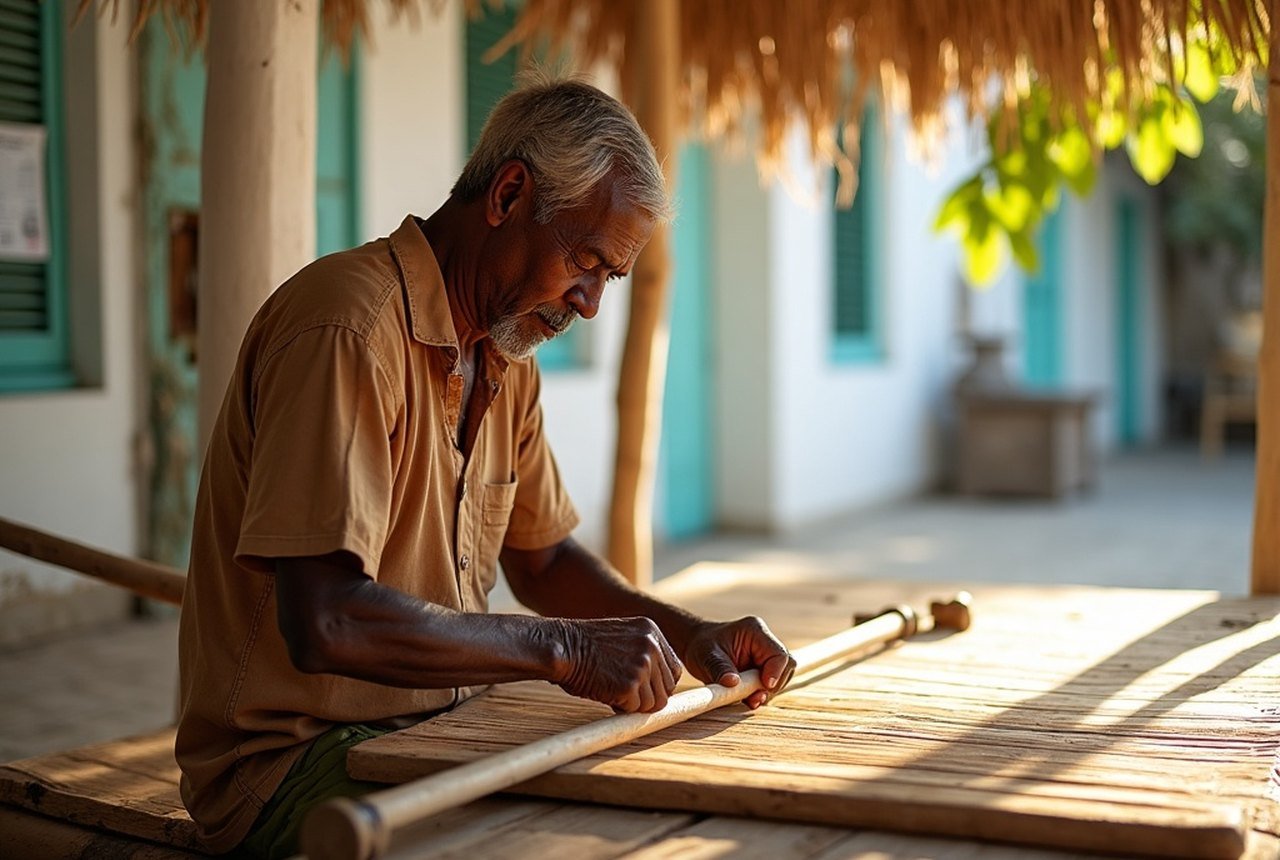
The reeds are harvested when young, split with a thumbnail or a fine blade, and left to dry before being dyed using traditional plant-based pigments — though chemical dyes have largely displaced them in recent decades for their reliability and brightness. Red, black, and natural cream are the classic palette; more elaborate pieces incorporate deep greens and warm yellows. A master weaver works on a low horizontal frame, building the mat from one end with a speed that makes the process look effortless and is anything but.
A full thundu kunaa of ceremonial quality — the kind presented as a gift at weddings or to mark occasions of state — can take weeks. Size matters less than density: the finest mats pack their weave so tightly that the surface feels almost textile-smooth rather than fibrous.
What Survives, and How
The Maldivian government has designated thundu kunaa weaving as an intangible cultural heritage practice, and the craft has attracted attention from UNESCO-aligned cultural bodies interested in documentation and preservation. The National Museum in Malé holds examples of historical mats, and the craft appears in cultural festivals in the capital. But recognition and practice are different things. The weavers who carry the finest techniques are predominantly older women on the source islands; younger generations, drawn toward education and employment in Malé or the resort economy, have less time and sometimes less incentive to spend weeks at the frame.
Some revival efforts exist at the community level — workshops, school programmes, attempts to create a market for high-quality thundu kunaa as a premium craft object rather than a utilitarian floor covering. The logic is sound: a mat that takes a skilled weaver three weeks to complete deserves a price reflecting that labour, and culturally curious travellers represent an audience that might pay it. Whether that market grows fast enough to give the next generation a reason to learn remains genuinely uncertain.
A Living Object
The best argument for thundu kunaa is the object itself. Hold a fine example and the tightness of the weave is immediately convincing — this is not a souvenir approximation but a disciplined, exacting craft with aesthetic standards that take years to meet. The patterns carry no single authoritative meaning; interpretations shift between islands and between weavers. That ambiguity is part of what makes them alive rather than archival.
Visitors who reach the inhabited islands of Gaafu Dhaalu will sometimes find weavers working in the shade of a breadfruit tree, the frame pegged low to the ground, the rhythm of the weave steady and unhurried. It is worth stopping. It is worth asking. And if a mat is for sale, it is worth understanding what you are holding.