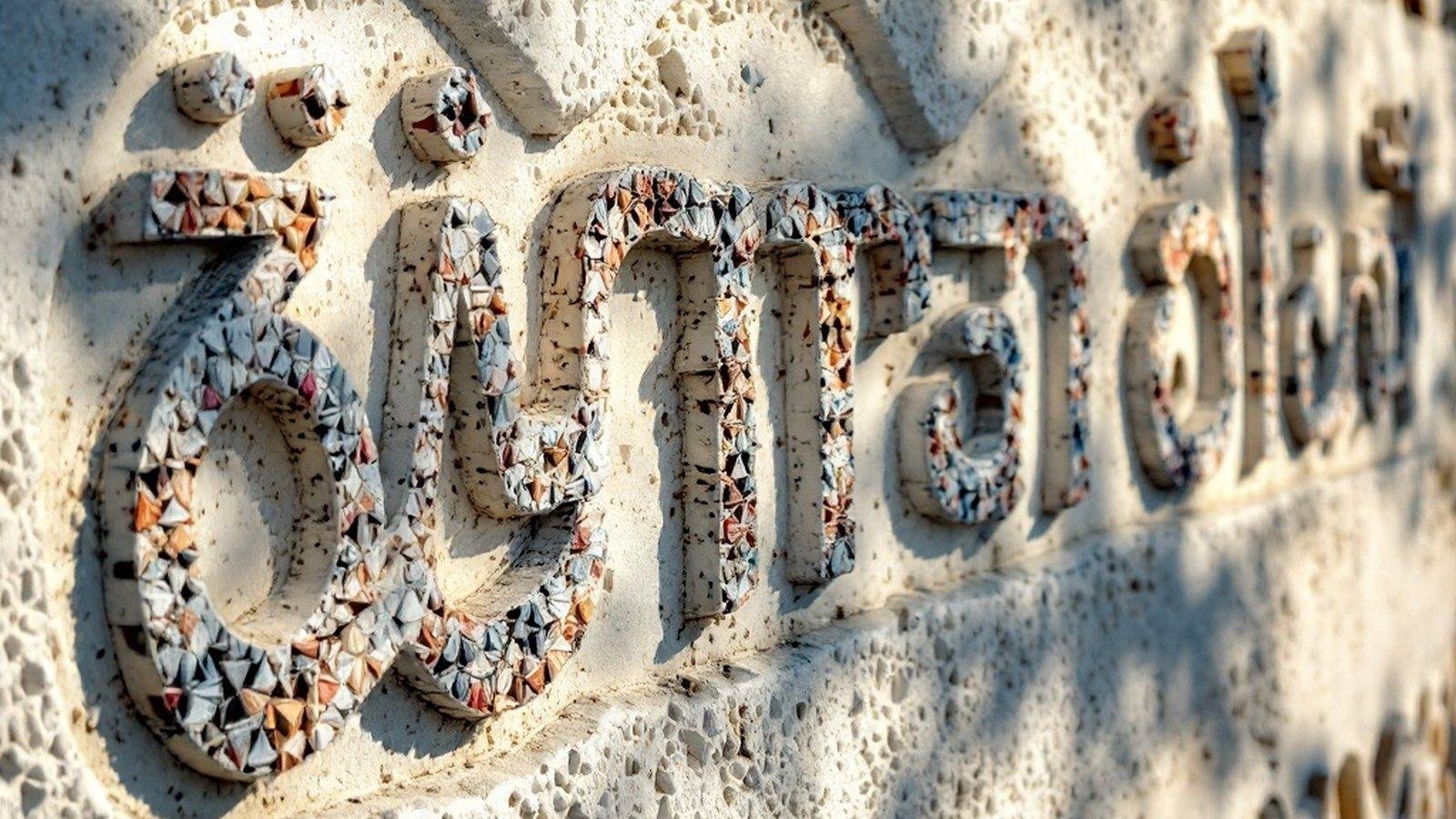
What Thaana Is
Writing systems usually carry fingerprints of the civilisations that shaped them. Thaana, the script used to write Dhivehi, is unusual: it draws from multiple traditions yet belongs entirely to the Maldives. Its letterforms derive partly from Arabic numerals, partly from Indic numerals, and partly from older Maldivian symbols — a layered ancestry that mirrors the archipelago's position at the crossroads of the Arabian Sea and South Asia. The result is a script unlike anything else on earth.
Thaana runs right to left, as Arabic does, and vowels are written not as independent letters but as diacritics — small marks placed above or below the consonants they follow. Learn to read it, and a single glance at a word gives you its consonant skeleton and its vowel sounds together, a compact efficiency that rewards the learner quickly. There are twenty-four letters in the script. Each has a distinct shape; very few resemble any character in any other writing system, which makes first encounters genuinely disorienting — and, for the curious, genuinely exciting.
The script you see written today was standardised and formally adopted under the Islamic Sultanate of the Maldives, and it has been in continuous official use since. Romanisation of Dhivehi exists and is widespread in informal digital communication, but Thaana remains the language's proper written form — used in government documents, school textbooks, literature, and the press. In 2023 the Maldives celebrated the centenary of Dhivehi literature as a modern written tradition, an occasion that brought renewed attention to the script's central role in national identity.

Letters, Sounds, and Structure
The twenty-four Thaana letters fall into two groups by origin. The first nine — haa through vaavu — are drawn from Arabic numerals, remade into consonant symbols. The next nine — meemu through daviyani — derive from Indic numeral forms. The remaining letters were developed locally to capture sounds specific to Dhivehi, including several that Arabic and Indic scripts have no need to represent. That three-part construction is not incidental: it is a document in miniature of who has traded with, settled in, and passed through these islands across the centuries.
Vowels work through a system of diacritics: ten vowel signs, plus the sukun, which marks the absence of a vowel. Written alone, a consonant is assumed to be followed by the inherent short a sound; add a diacritic and you change or extend that vowel, or indicate that no vowel follows at all. Mastering this system is the central task for anyone learning to read Thaana, and it comes faster than it looks. The script is phonemic — it spells what it sounds — so once you know the letters and diacritics, unfamiliar words can be sounded out immediately.
One practical quirk for the modern world: Thaana is RTL, right to left, while the numbers used alongside it in Dhivehi texts run left to right, as in most of the world. A line of Maldivian text containing a figure therefore contains a directional switch mid-sentence. Digital rendering handles this gracefully now, but for decades it made Dhivehi typesetting genuinely complicated.
Why It Matters
Language is identity, and script is the visible skin of language. Thaana does not just record Dhivehi — it marks out a distinct people, a distinct place, a distinct way of organising sound into meaning. In a country where roughly 400,000 people are spread across more than 1,100 islands, a shared script is a thread that holds. Walk through Malé and Thaana is everywhere: on shop signs, mosque walls, government buildings, the sides of dhoni. It is the first thing a Maldivian child learns to form with a pen.
For visitors, engaging with even the basics of Thaana is one of the most direct ways to step past the resort-brochure version of the Maldives. You do not need to read fluently to appreciate what the script represents: a small island nation, remote by any measure, that developed its own writing system and kept it. That tenacity is worth paying attention to.
This guide covers the full structure of Thaana — letterforms, diacritics, pronunciation, and the history behind each section of the alphabet. Start with the letters. The rest follows.