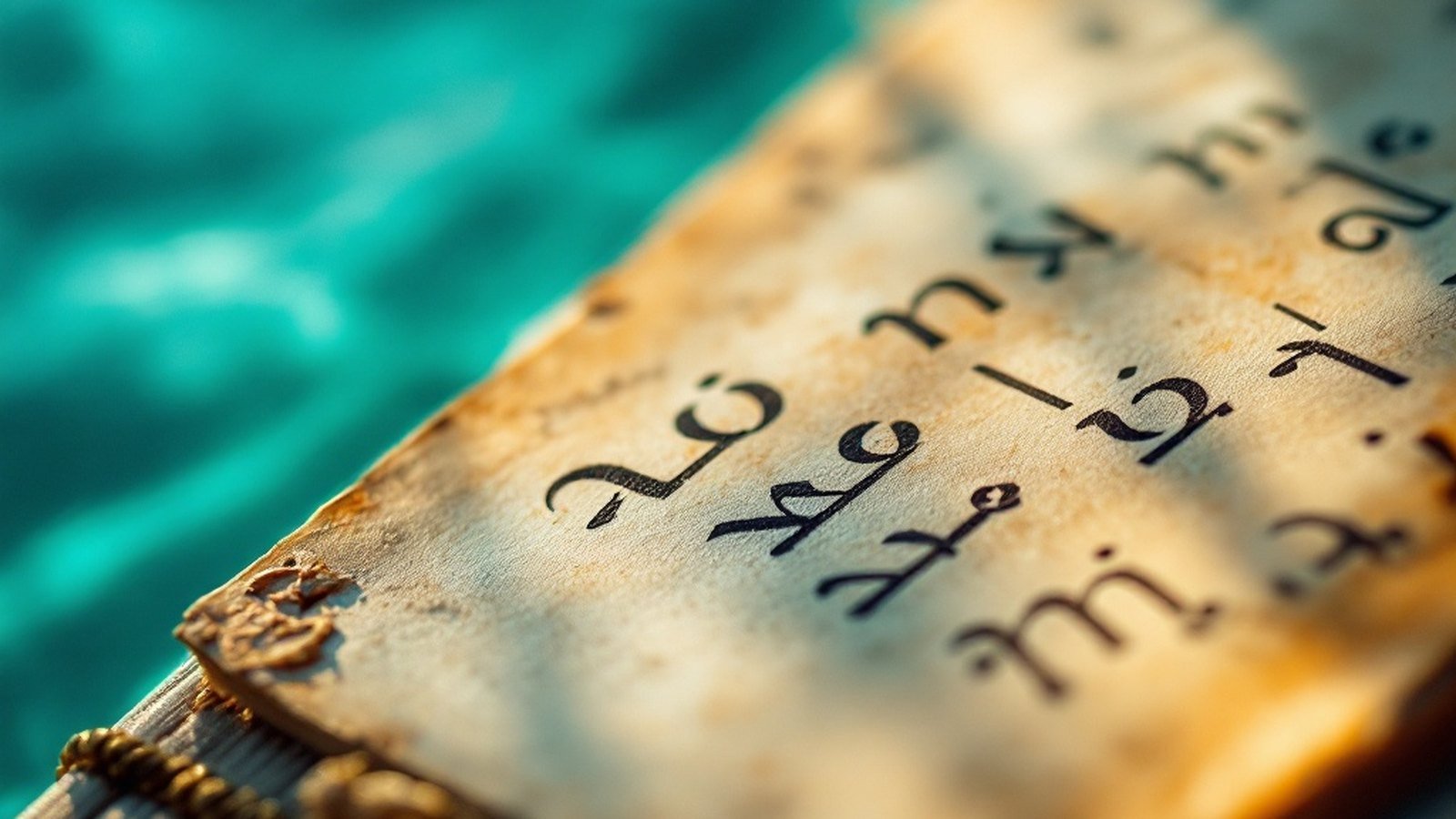
A Living Alphabet
There is something quietly arresting about watching Dhivehi written out by hand. The letters unspool from right to left across the page, each consonant wearing small diacritical marks above or below it to signal its vowel — a system so compact and logical that it feels almost engineered. Which, in a sense, it was.
Thaana is the unique script used to write Dhivehi, the language of the Maldivian people, and it stands apart from every other writing system in South Asia. It does not descend from the Brahmi family that underlies most of the region's scripts. Instead, its first nine letters are derived from Arabic numerals, and the next nine from Indic numerals — an origin that encodes, in the very shapes of the alphabet, the twin currents of trade and faith that have always moved through this archipelago. The remaining letters were added later, largely so that loanwords and Arabic could be written. The result is a hybrid with no close relatives: distinctly Maldivian, beholden to no single tradition.
Like Arabic, Thaana runs right to left — RTL in typographic shorthand — and like Arabic it uses vowel diacritics rather than separate vowel letters. A reader who knows the system can move through a Dhivehi text with remarkable speed; a learner arriving from a Latin-script background has to rewire nearly every assumption about how a page works. That disorientation, brief as it is, is actually instructive. It is a reminder that the Maldives was never a peripheral outpost of some larger civilisation. It had its own intellectual life, its own conventions, its own way of organising knowledge on a page.
- Pre-1153Dives Akuru script in use; Buddhist and Hindu cultural influence
- 1153Islam adopted; Arabic literacy enters the archipelago
- Post-1153Thaana develops, drawing on Arabic and Indic numeral forms
- PresentThaana official script of the Republic of Maldives; co-exists with informal Romanisation
Script and History, Intertwined
Understanding Thaana means understanding something of the longer arc of Maldivian history — because the script itself changed as the islands changed.
Before the adoption of Islam in 1153, the Maldives was shaped by Buddhist and Hindu influences, and the islands used Dives Akuru, an older script that survives today mainly in stone inscriptions and copper-plate records. The conversion to Islam — traditionally attributed to the Moroccan scholar Abu al-Barakat — brought Arabic literacy and a new religious culture into the archipelago. Over the following centuries, as Islamic scholarship and Indian Ocean trade deepened together, Dhivehi writing absorbed Arabic and Indic numeral forms and gradually evolved into the Thaana system used today. The script, in other words, is a compressed history of the islands: pre-Islamic substratum, Islamic overlay, and maritime-trade influence, all fused into something new.
That fusion matters because it is precisely the Maldivian pattern. The archipelago was never isolated — it sat at the crossing of routes linking Arabia, India, and East Africa — but it was also never absorbed. It traded, adapted, and remained itself. Thaana is an emblem of that dynamic: open to influence, resistant to replacement.
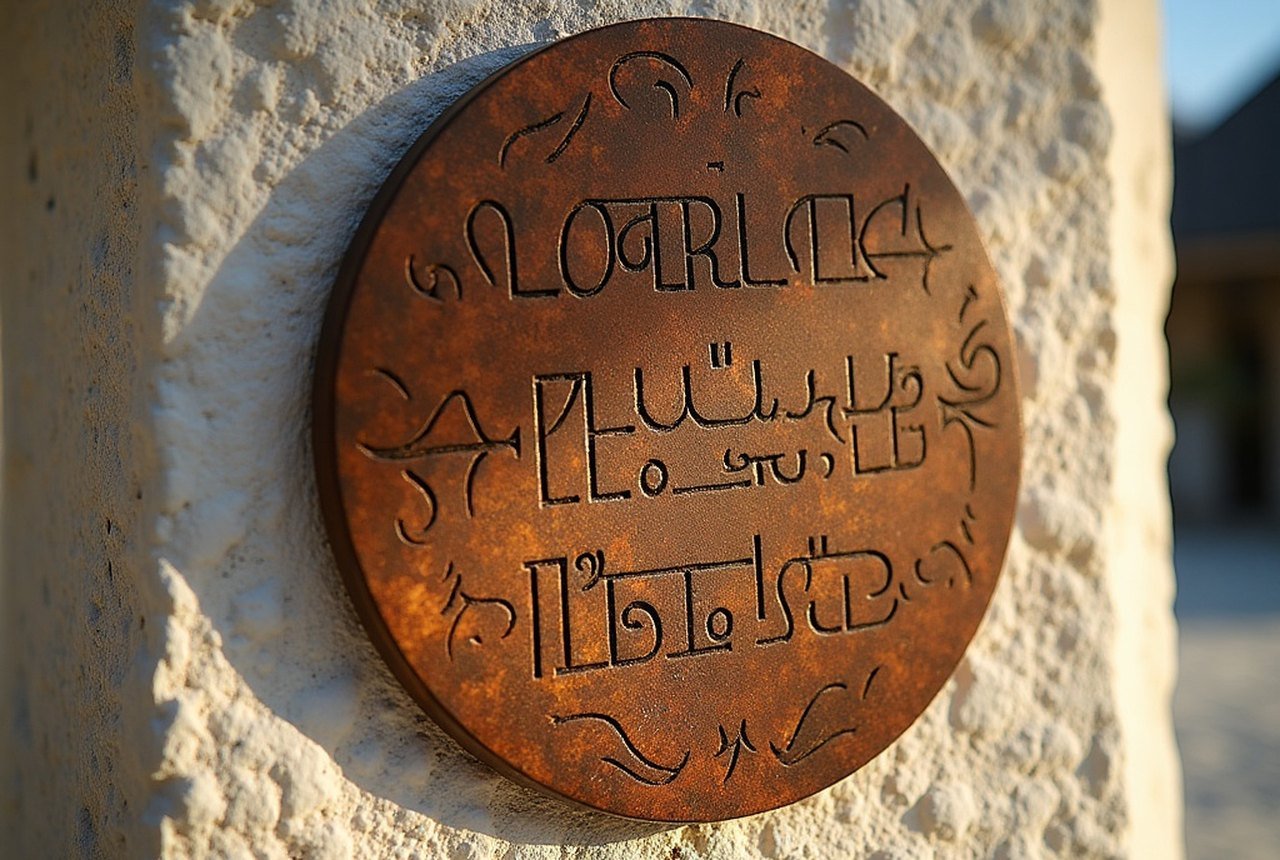
Today, Thaana is the official script of the Republic of Maldives. It is used for government documents, literature, journalism, and daily text messages on phones across the archipelago. Romanisation — converting Dhivehi sounds into Latin letters — is widespread in informal digital writing, and younger Maldivians move fluidly between the two systems. But Thaana has not retreated. Signage in Malé, school textbooks, the mastheads of newspapers: the script is present and unambiguous. It is not a museum object; it is a working alphabet used by a population of more than 400,000 people.
What a visitor to the Maldives tends to notice first is the landscape — the improbable blue of the lagoons, the low coral islands barely clearing the waterline. What they rarely notice, unless they are looking, is the script running right to left on every official sign they walk past. That rightward-to-leftward movement is worth pausing over. It is the Maldives, as it so often is, doing things its own way — shaped by the world, but never quite like anywhere else in it.