A Nine-Century Thread
The Maldives carries one of the longest continuous religious histories in the Indian Ocean. For centuries before Islam arrived, the archipelago followed Buddhism — a tradition that almost certainly reached these islands through the same trading networks that moved cinnamon, cowrie shells, and dried tuna across the Indian Ocean world. Connections to the Indian subcontinent were old and well-worn, and Buddhist practice appears to have taken firm hold: the ruins of ancient havitta mounds found on inhabited islands across the atolls are read by archaeologists as the remains of Buddhist stupas.
That era ended decisively in 1153. King Dhovemi converted to Islam, and with him the islands. Six successive Islamic sultanates followed over the coming centuries, each one consolidating what the conversion had begun. Arab traders and scholars had already been working these sea routes for generations — preaching, trading, marrying into island communities — and the new faith settled into Maldivian life with a thoroughness that has never been reversed.
Today, Sunni Islam is enshrined as the official state religion and sits at the foundation of civil law. The constitution reserves citizenship for Muslims. Schools are required to incorporate Islamic instruction. Friday prayers bring offices, shops, and government business to a standstill across every atoll, from Malé to the southernmost islands of Addu. These are not symbolic gestures: they are the operating system of Maldivian public life.
What Persisted Beneath
Because the Maldives sat at a real remove from the great centres of the Muslim world — from Cairo, from Baghdad, from Delhi — the conversion was thorough without being totalising. A layer of pre-Islamic folk belief survived quietly beneath the surface, and it survives still.
Oral traditions, folk tales, and certain customary practices never disappeared. The figure of Rannamaari, the sea demon said to have demanded human sacrifice from the islanders before Abu al-Barakat's arrival banished it, belongs to this older world — half-remembered, still told. The practice of fandita, traditional sorcery or protective magic, has its roots in the pre-Islamic period and continues to circulate in island life, sometimes uneasily, sometimes matter-of-factly. These are not rival religions. They are living cultural memory, folded into a society that is, by any measure, sincerely and observantly Muslim.
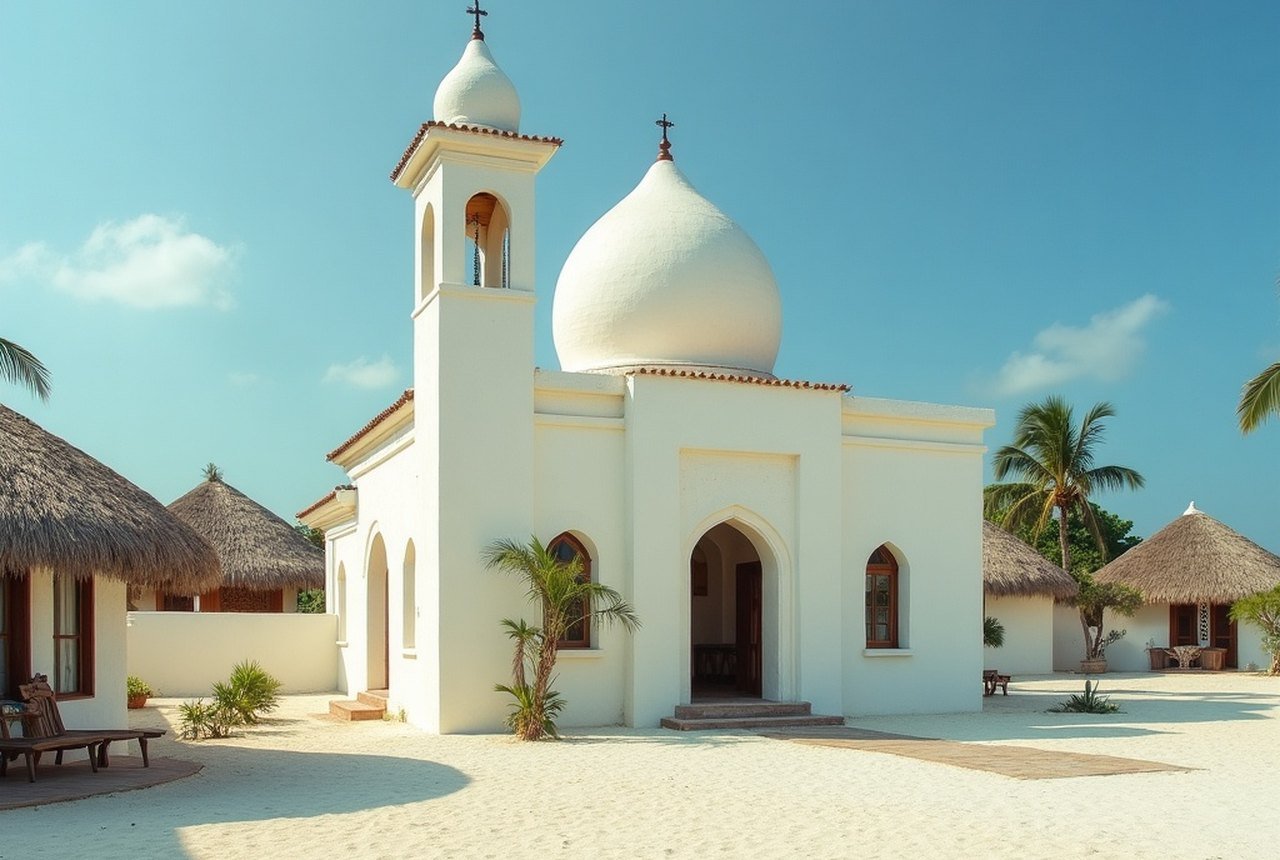
The mosques themselves carry this layered story in their fabric. Most across the atolls are modest structures — whitewashed coral stone, a shaded courtyard, a minaret that barely clears the palm canopy. They are functional, unshowy, and deeply embedded in their communities.
- Pre-12th centuryBuddhist practice established across the archipelago
- 1153King Dhovemi converts; Islamic sultanate begins
- 1656Hukuru Miskiy built under Sultan Ibrahim Iskandar
Hukuru Miskiy and the Tomb of the Converter
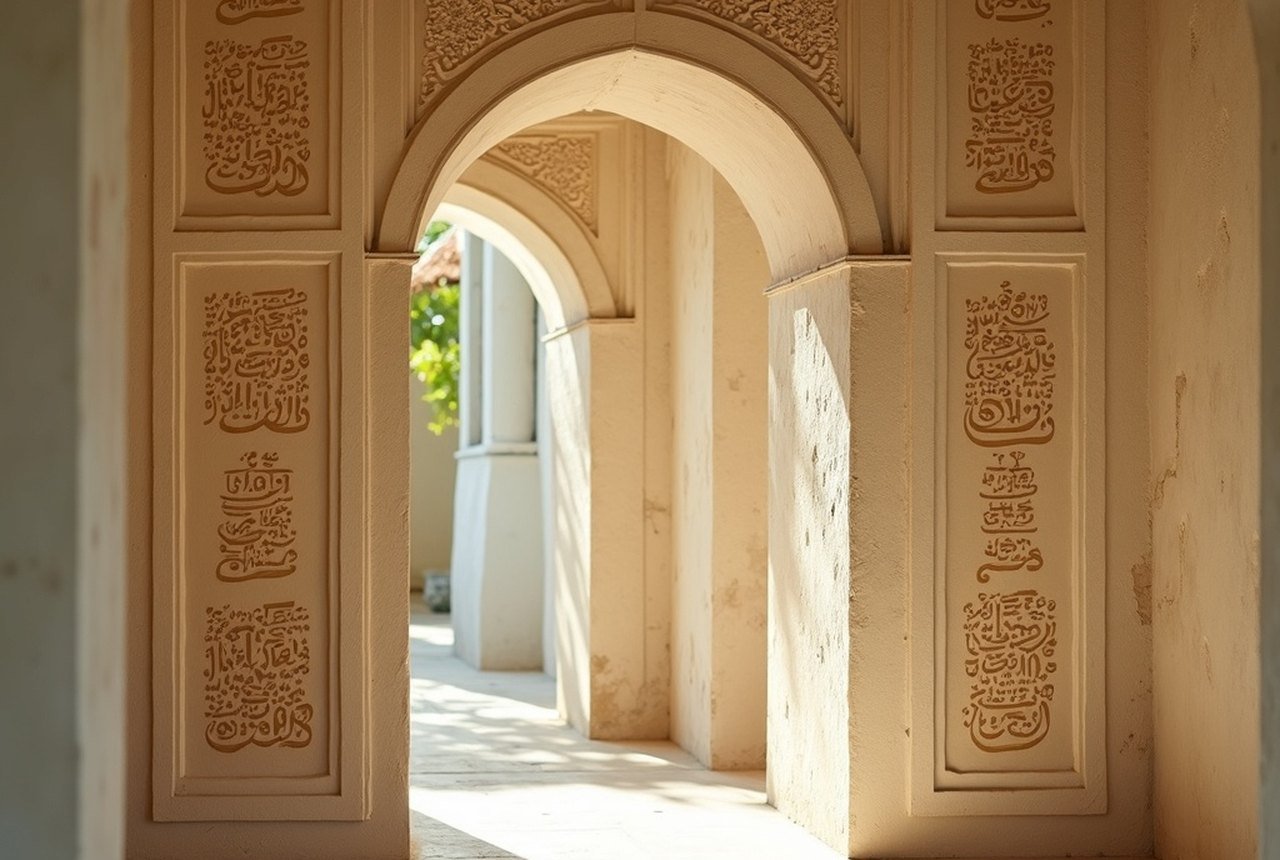
The most significant of all is Hukuru Miskiy in Malé — the Old Friday Mosque, built in 1656 from coral stone during the reign of Sultan Ibrahim Iskandar. It is the oldest mosque in the Maldives, and arguably the most historically dense building in the entire country. The craftsmanship is extraordinary: the interior walls carry intricate coral-stone carvings alongside panels of Thaana script, recording religious inscriptions and royal dedications in the flowing right-to-left lettering that is unique to the Dhivehi language.
Within Hukuru Miskiy stands the tomb of Abu al-Barakat — the scholar credited with bringing Sunni Islam to the Maldives and, by the traditional account, with converting King Dhovemi himself in 1153. Whether the full story is precisely as legend tells it, or whether the conversion was a slower, more complex process shaped by generations of Arab contact, the tomb remains a place of genuine reverence. Hukuru Miskiy is still an active mosque, not a museum piece: worshippers arrive for daily prayers, and on Fridays the lanes around it fill.
For a visitor trying to understand the Maldives beyond the resort, this is the essential starting point. Islam here is not nominal or ceremonial. It structures law, education, the rhythm of the week, and the texture of social life across more than a thousand islands. It also coexists — quietly, sometimes tensely — with folk beliefs and oral traditions that predate it by centuries. That layered relationship, between formal faith and deep cultural memory, is one of the things that makes Maldivian culture genuinely worth understanding.