Finding the Layers
Malé is one of the world's most crowded capitals, a grid of concrete barely two kilometres across. The resort Maldives feels very far away here. And yet, tucked between the phone shops and the ferry terminals, the city carries genuine historical depth — you just have to walk slowly.
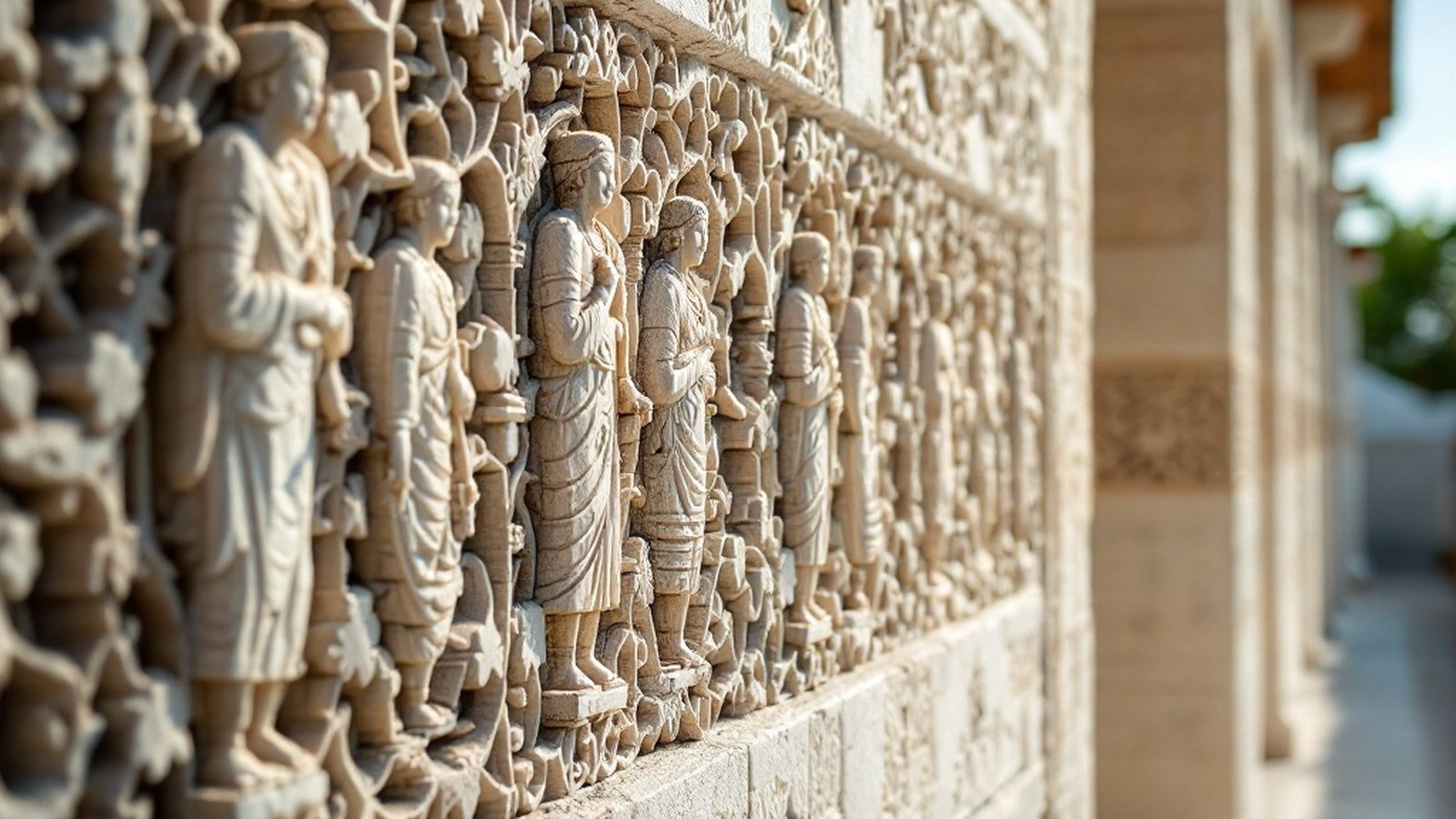
Start at Hukuru Miskiy, the Old Friday Mosque, built in 1656 on the orders of Sultan Ibrahim Iskandar. It is the finest surviving example of coral-stone craftsmanship in the archipelago: every surface — walls, tombstones, mihrabs — carved with interlocking arabesques and lacework script in Thaana and older Dhivehi hands. The carved coral is honeyed and precise, the work of craftsmen who understood the reef as intimately as they understood geometry. Shoes off, voices low. This is a living mosque, still used for Friday prayers.
A short walk brings you to Sultan's Park, the modest public garden occupying what was once the grounds of the old royal palace. The palace itself is long gone, demolished in the twentieth century, but at the garden's edge stands the National Museum of the Maldives, housed inside a surviving fragment of the royal complex. Here you can trace the arc of the Islamic Sultanate of the Maldives through its regalia, coins, and manuscripts — including rare lacquerware and royal ceremonial objects that have no parallel elsewhere in the Indian Ocean.
Nearby, Muleeaage — built as a palace in the early twentieth century, now the President's official residence — wears its colonial-era grandeur a little awkwardly behind a perimeter fence, but it rewards a pause. From here it is a short walk north to the waterfront, where the old harbour has been reshaped by reclamation yet still pulses with dhoni traffic, the traditional wooden boats arriving from outer atolls loaded with fish and produce.
None of this is a museum quarter. It sits inside a functioning, fast-changing city. That friction is the point: old Malé does not preserve itself picturesquely — it survives by insisting on being used. The coral mosque stands because people pray in it. The park is crowded because people need shade. Come not expecting stillness, but expecting a city that has been continuously, stubbornly inhabited for centuries — and shows it.