The Rhythm That Runs the Islands
Before clocks and phone screens, islanders measured the day by light, tide, and the call to prayer. That ordering hasn't disappeared. Across nearly two hundred inhabited islands, the adhan rings out five times between the grey hour before dawn and the quiet after dark, and life — visibly, audibly — adjusts around it. Shops pull their shutters. Fishing boats hold their departure. Conversations pause mid-sentence.
The Maldives has been Sunni Muslim since the twelfth century, when Abu al-Barakat is credited with converting King Dhovemi and establishing Islam as the faith of the sultanate. Centuries on, the religion is threaded into daily routine rather than reserved for weekly observance. Friday prayers are the communal high point — offices close, the streets of Malé empty, and the lanes around Hukuru Miskiy, the seventeenth-century coral-stone mosque at the capital's old heart, fill with worshippers spilling onto the pavement — but the five daily prayers are the quieter, persistent pulse.
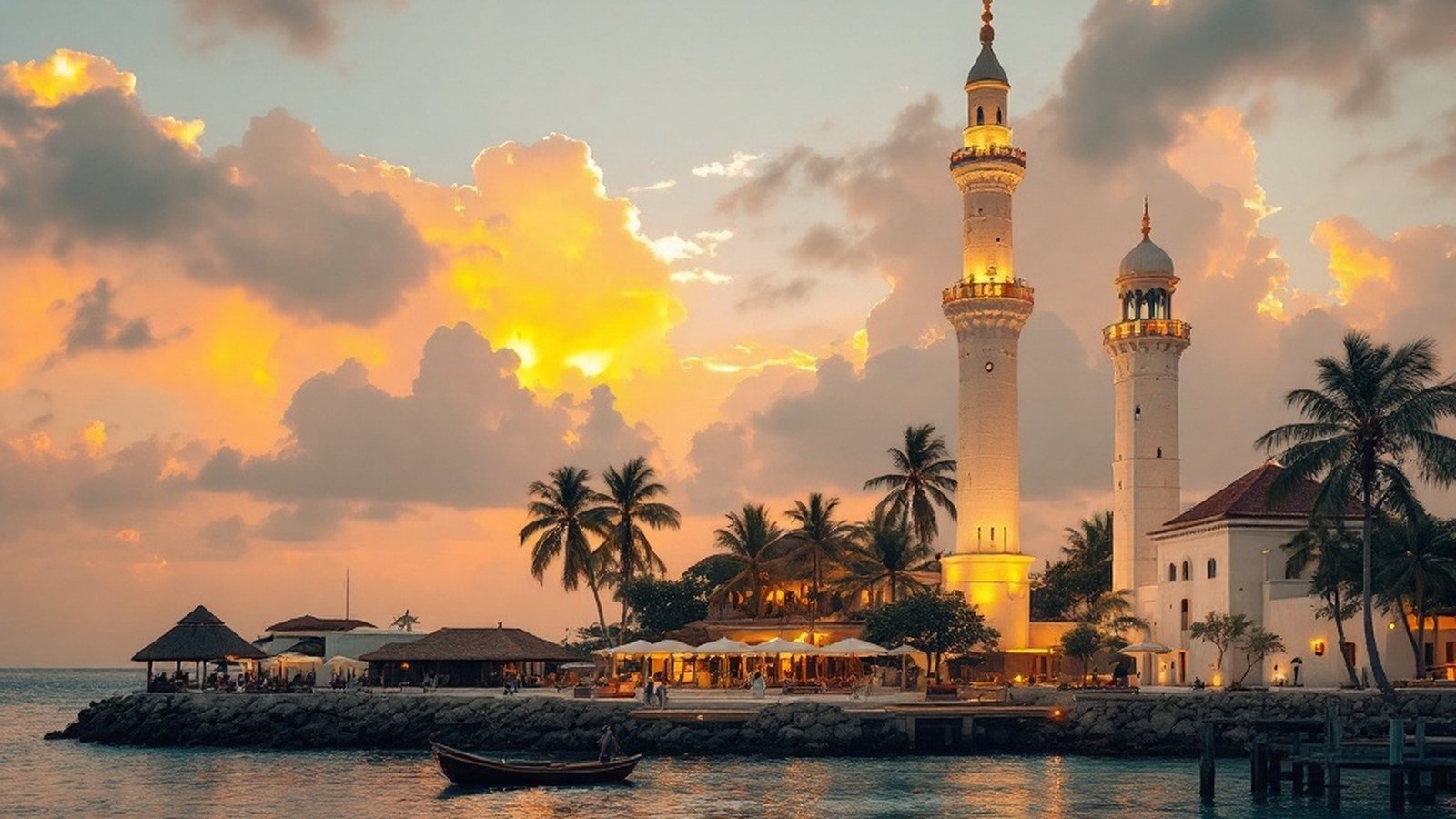
On a small island, the adhan carries differently than in a city. There is no ambient noise to absorb it. A muezzin's voice, or today more commonly a loudspeaker mounted on the minaret, reaches the shoreline easily, crossing the width of most islands in seconds. Fishermen at the lagoon edge hear it clearly. So does the woman grinding dried tuna in her kitchen, and the children playing on the beach. The call is an acoustic fact of the place, not background sound.
Visitors who spend time on inhabited islands rather than resort islands often describe the adhan as the most disorienting and then the most grounding feature of daily life. The disorientation comes first — a pre-dawn call at Fajr, around five in the morning, is genuinely startling in an open-sided guesthouse. The grounding comes later, once the body starts to anticipate the rhythm: the day has shape, five reliable points of orientation, however the hours between them drift.
That structuring quality is perhaps the adhan's least visible function. On atolls where geography already imposes a particular relationship with time — tides, seasons, the slow traversal of light across open water — the call to prayer adds a human layer of regularity. It says: here, now, this matters. Five times, every day, across every island.