|
|
Ibn Battuta 1304-1368/69
(introduction from Wikipedia)
In 1354 and 1355, the Moroccan Ibn Battuta dictated an account of his journeys
to a scholar named Ibn Juzayy, whom he had previously met while in Granada,
Spain.
This account, recorded by Ibn Juzayy and interspersed with the latter's
own comments, is the only source of information on his adventures.
The Arabic title of the manuscript may be translated as 'A Gift to Those Who
Contemplate the Wonders of Cities and the Marvels of Travelling' but is often
simply referred to as the Rehla, or 'The Journey'.
For centuries
his book was obscure, even within the Muslim world, but in the early 1800s extracts
were published in German and English based on manuscripts discovered in the
Middle East containing abridged versions of Ibn Juzayy's Arabic text.
When French forces occupied Algeria in the 1830s they discovered five manuscripts
in Constantine including two that contained more complete versions of the text.
These manuscripts were brought back to the Bibliotheque Nationale in Paris and
studied by the French scholars, Charles Defremery and Beniamino Sanguinetti.
Beginning in 1853, they published a series of four volumes containing the Arabic
text, extensive notes and a translation into French. Defremery and Sanguinetti's
printed text has now been translated into many other languages. Ibn Battuta
has grown in fame and is now a well-known figure.
.............................
The Maldive Islands, Dhibat-ul-Mahal part 1 Chapter 16 from the English translation by Dr. Mahdi Husain The Rehla of Ibn Battuta - India, Maldive Islands and Ceylon - translation and commentary Oriental Institute, Baroda, India 1976
| |
 Ibn Battuta's voyages between India, Maldives and Ceylon 1344-46 from Mahdi Husain's Rehla translation 1976
|
I resolved to undertake a journey
to the Maldive islands (Dhibat-ul-mahal), of which I had heard a lot. Ten days
after we had embarked at Calicut we reached the Maldive islands. These islands
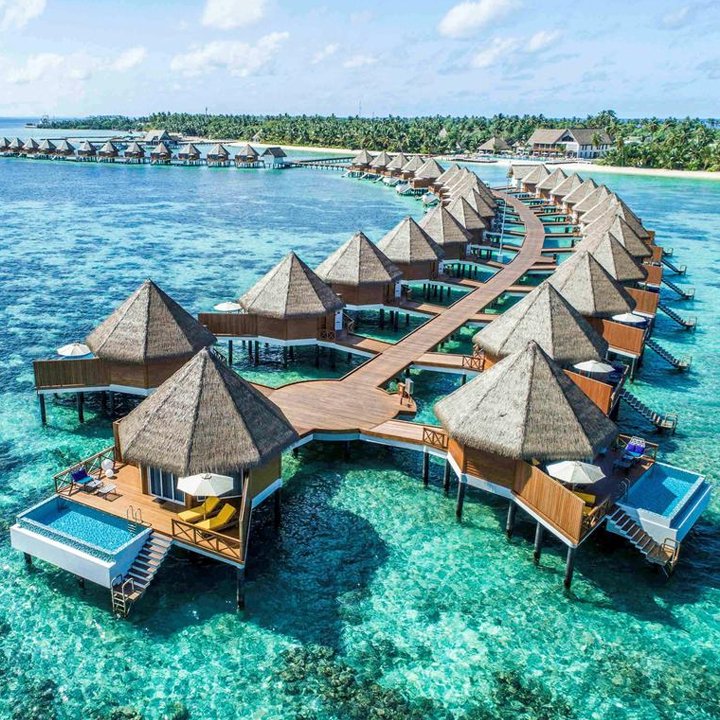
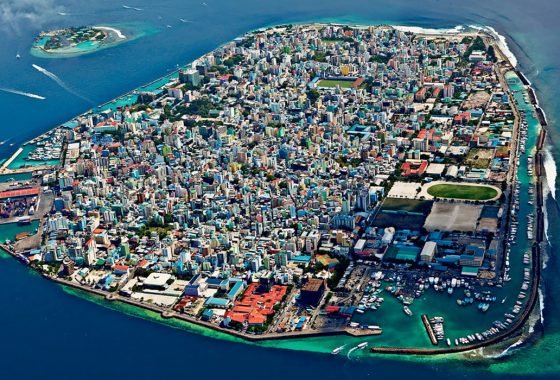
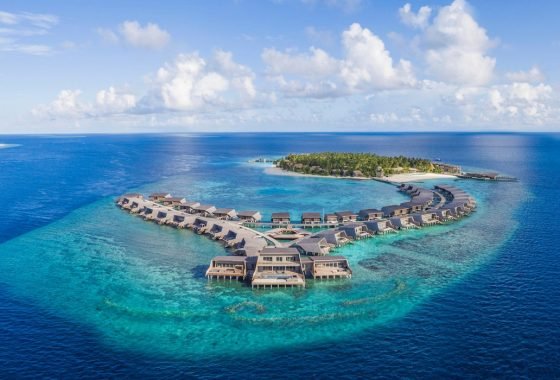
are to be reckoned as one of the wonders of the world. There are about two thousand
of them of which a hundred or less form together a cluster round-shaped like
a ring and have an entrance similar to a gate by which alone ships can enter.
When a ship comes to one of these islands it is absolutely necessary for her
to have a native pilot in order to be able to put in at the other islands under
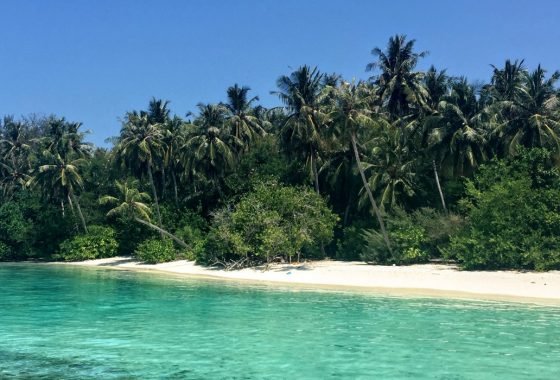
his direction. They are so close to one another that the tops of the palm trees
in one island are visible from another when the ship is putting out to sea.
And if a ship misses the direction of the islands she cannot reach them, and
the wind drives her to M'abar or to Ceylon.
All the inhabitants of
these islands are Muslims - religious and upright people. And the islands are
divided into atols, each of which is administered by a governor who is called
kardui.
The atols are: the atol of (1) Palipur (Balebur), (2)
Kannulus (Kinolhas), (3) Mahal - an atol after which all the islands are named and where
resides the rulers thereof, (4) Taladib, (5) Karaedu, (6) Taim, (7) Taladummati,
(8) Haladummati - which is like the preceding word except with the initial letter
'ha', (9) Baraidu, (10) Kandakal, (11) Muluk and (12) Suwaid - which lies
at the farthest extremity.
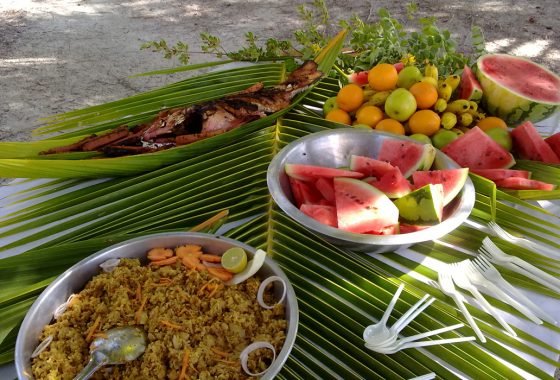
In all these islands there grows no grain;
only in the Suwaid region is to be found a kind of grain which resembles millet
and is exported from there to Mahal. The food of the inhabitants is a fish which
is similar to 'lyrun' and which they call qalb-almas. Its flesh is red and has
no grease and smells like mutton. When it is caught the fish is cut into four
pieces, cooked a little, placed in baskets of palm leaves and hung over the
smoke. When it is thoroughly, dry it is eaten. It is exported from the Maldive
islands to India, China and Yemen; it is called qalb-almas.
Trees
of the Maldive islands Most of the trees these islands
are those of coconut which forms the diet of the inhabitants together with the
fish already mentioned. The coconut trees are wonderful, and a tree bears yearly
twelve racemes of coconuts, one raceme every month. Some of the coconuts in
the raceme are small, some large, some dry, some green, and thus it continues
forever. Milk is made from them as well as oil and honey, as we have described
in the course of the first journey. From the honey they make a confectionery
which is eaten with dried coconuts.
From all this and from the species
of fish on which they live, the inhabitants acquire a remarkable and incomparable
sexual vigour, and the islanders are astounding in this respect. I myself had
in this country four wives besides slave girls. Every day I visited all of them
and passed the night with one whose turn it was, and I remained there in this
way for a year and a half.
Other trees of the archipelago are jaman,
orange, lemon and colocasia. From the roots of colocasia they prepare a flour
from which is made a kind of vermicelli, which is cooked with coconut milk and
is one of the best foods. I found it very good and loved to eat it.
Inhabitants
of these islands and some of their customs and their dwellings The
inhabitants of these islands are upright and religious and are men of right beliefs
and good intentions. Their diet is consistent with the Islamic law and their
prayers are accepted by the Almighty God. When one man meets another he says
to the latter, 'God is my lord, Muhammad my prophet and I am a poor ignoramus'.
Their
bodies are weak and they are not used to fighting, and in war their arms are
prayer. Once in this country, I commanded the hand of a thief to be cut off
whereupon several natives who were present in the court fell into a swoon.
The Indian robbers refrain from attacking them for they know from their past
experience that whoever seizes anything from them meets quickly with a misfortune.
When enemy ships come into their territories they seize the foreigners whom
they meet, but do no harm to any of them. When an infidel takes anything, even
a lemon, the chief of the infidels punishes him with painful blows inspiring
fear of the consequences. If it were not so, these people would be easily overcome
by any intending attacker because of the weakness of their physique.
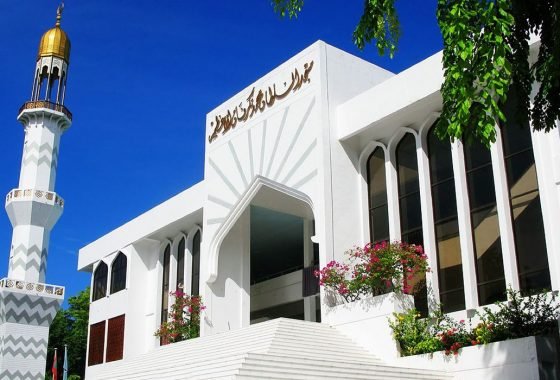
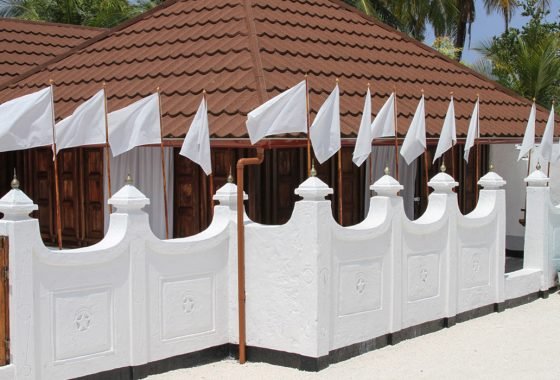
In every island of the archipelago there are beautiful mosques and for the most
part their edifices are made of wood. The inhabitants are clean and abstain
from dirty things and most of them wash twice a day to keep themselves clean
having regard to the great heat of the archipelago and the great amount of perspiration
shed. They use much perfumed oil, that is, the sandal oil and the like, and
smear themselves with a kind of musk perfume brought from Mogdishu. There is
a custom in these islands according to which every woman goes to her husband
or to her son with a collyrium case and with rosewater and ghalia oil (composed
of musk and ambegris) after the performance of the morning prayer. And he applies
the collyrium to both of his eyes, and annoints himself with rosewater and the
ghalia oil. As a result, his skin takes on a polished appearance and ghastliness
disappears from his face.
Their clothing consists of a waist wrapper;
they bind this round their middle instead of the trousers and put round their
shoulders an article of clothing called wilyan which looks almost like an ihram
(a piece of cloth used by moslems during the haj). Some put on a turban, while
others wear a small kerchief. When any of them meets the judge, qazi, or the
orator, khatib, he removes his garment from his shoulders, bares his back and
accompanies him thus until the latter reaches his house.
One of their
customs is that when any man from among them marries and goes to the house of
his wife, she spreads linen cloth in his honour from the roof of her house to
the wedding-chamber and along the cloth she places handfuls of cowries to the
right as well as to the left of his path up to the wedding-chamber at the door
of which she herself stands awaiting him. When he comes to her, she throws an
article of clothing at his feet which is picked up by his servants.
In
case the wife goes to the husband's house, it is the husband's house which is
floored and bestrewed with cowries. On her arrival at her husband's house the
wife throws the linen cloth at his feet.
Such is also the custom
of these islanders when they greet the sultan, and it is absolutely necessary
to have a piece of cloth which is thrown down at the time of greeting. We shall
speak of it later.
Their buildings are made of wood, and they arrange
the floors of their houses high above the ground as a protection against damp,
since the earth in their country is moist. The process of construction with
them is as follows: they fashion blocks of stone two or three cubits long, place
them in rows one above the other and lay upon them beams of coconut wood. Thereupon,
they raise walls of wood - an art in which they are wonderfully skilled. And
they build in the portico of the house a chamber called maalam, in which the
house owner sits with his friends. It has two doors through one of which facing
the portico enter the visitors; while through the other at the side of the house
enters the owner. Near this chamber there is a large vessel full of water which
has a bowl called walanj, which is made of the coconut shell. It has a handle
two cubits long with which one can draw water from the wells since the water
is near.
Almost all the inhabitants, high as well as low, walk barefooted,
and their streets, swept clean, are shaded by trees so that the walker feels
he is in a garden. Despite all this, everyone entering a house must wash his
feet with the water to be found in the large vessel at the maalam, and dry them
on a thick mat of palm fibres which lies there, and then he enters the house.
In the same manner acts everyone who enters a mosque.
Treatment
of foreign visitors It is the custom in these islands that
when a ship puts in there, the kanaadir, that is, small boats - the singular
of the word is kandura - sail out to meet it. On these are inhabitants of the
island who have with them betel and karamba, that is, green coconuts. And everyone
offers these according to his choice to one of the passengers, who thereupon
becomes his guest, and he takes his luggage to his house as if he were a relative
of his.
Any of these guests who wishes to marry can do so. When the
time comes for the departure he divorces his wife as women do not leave the
country. Whoever does not marry has his food cooked by the hostess in whose
house he is staying. She serves him and supplies provisions when he leaves,
and she accepts quite a small present as recompense.
Trade The
revenue of the treasury which is there called bandar, is derived from the purchase
of a certain part of every kind of merchandise on board at a price fixed by
the officials, whether the goods are worth this price or more. This is called
the law of the bandar. And for the bandar there is on each island a wooden house
called bajansar in which the governor, who is called karduvari, stores up the
goods, sells them and buys them.
The inhabitants of these islands
buy crockery, on being imported to them, in exchange for fowls so that a pot
sells in their country for five or six fowls. The vessels take from these islands
the fish which has been mentioned before, coconuts, waist-wrappers, wilyan and
turbans made of cotton. And people take from there copper vessels which are
abundant with the Maldivians as well as cowries and qanbar, that is the fibrous
covering (coir) of the coconut. This is tanned in pits on the shore, beaten
with mallets and then spun by the women. Ropes are made from it which are used
to bind the ships together and are exported to China, India and Yemen; these
ropes are better than those made from hemp, and with these ropes the beams of
the Indian and Yemenite ships are sewn together for the Indian ocean has many
rocks. If a ship nailed together with iron nails collides with rocks, it would
surely be wrecked; but a ship whose beams are sewn together with ropes is made
wet and is not shattered.
All transactions take place in this country
by means of the cowrie, which is an animal picked from the sea and deposited
in pits on the shore. Its flesh disappears and only the white bone remains.
A hundred cowries are called siyaah, seven hundred faal, twelve thousand kutta,
and one hundred thousand bustu. They are used for buying and selling at the
rate of four bustu for one gold dinar. Sometimes the cowries depreciate, and
in that case even ten bustu can be had for one dinar. They are sold to the
inhabitants of Bengal for rice, because the cowries are also current in Bengal,
and also to the inhabitants of Yemen who use these instead of sand as ballast
in their ships. The cowrie is also the currency of the Sudanese in their country.
I saw one thousand one hundred and fifty cowries sold for one gold dinar in
Mali and Juju.
|
|
|