Carl Rosset in Male', Maldives 1885 - original photos and lithographs Text and graphics
by Carl Wilhelm Rosset from The Graphic 16 October 1886, and
Illustrierte Zeitung 23 April 1887
| |
Young Maldivian man in
Male' Photo: C. W. Rosset, 1885
|
Carl
Wilhelm Rosset was a doctor and explorer, born in Freiburg, Wurttemberg,
Germany in 1851, who took photographs and collected artefacts and specimens
while staying in Male' from 29 October until 21 December 1885.
Most of Rosset's
photos were probably destroyed in Berlin in 1945 at the end of World War
II.
The article below is Rosset's full English account of his
visit published by The Graphic in 1886, plus coloured
additions from a shorter but more frank and revealing German language article
by Rosset in Illustrierte Zeitung in 1887, translated
here by the Swedish Maldivian history researcher Lars Vilgon.
Rosset's
acquisitions, collected with the help of the leading minister Atireege Ibrahim
Didi (Abrahim Deedee in the article), formed the major part of displays
of Maldivian products, manufactures and cultural items at exhibitions in
London, Berlin and Chicago.
Rosset also published articles about
Maldives with the Zoological Society of London and the Anthropological Institute
of Great Britain and Ireland.
The preparations for my visit to these islands were commenced in the spring of
1884, as it had been my intention to proceed thither in October of that
year; but a combination of accidents prevented my departure from Colombo
at the appointed time, and I had therefore to wait 12 months for another
opportunity.
This delay was unavoidable owing to the fact that
the high sea which prevails around the islands during the southwest monsoon
(i.e. from June to September) makes landing there a rather dangerous matter,
especially if one is cumbered with boxes of instruments and stores. It was
necessary for me to arrive there soon after the setting in of the end of
the north-east monsoon about the middle of October, so as to have as long
a spell of fine weather as possible.
Seeing that the Maldives
were a dependency of the government of Ceylon before that colony passed
into the hands of the English in 1796, it cannot but be a matter of some
surprise that the information possessed concerning them should be of such
meagre description.
The Maldivians have long been known as a
peaceful and hospitable race, though shy and suspicious with strangers until
they have satisfied themselves of the latter's friendly intentions: they
are not too conservative to oppose the adoption of new ideas if these are
properly introduced: nor are they deficient in commercial aptitude.
One
cause of the islands having been so much neglected is undoubtedly to be
found in the bad reputation acquired by the climate: and another is probably
a certain reluctance on the part of the Ceylon government to meddle, or
appear to meddle, with the affairs of the Maldivians. I am
not by any means the first European who has paid a visit to the Maldives;
but I can justly claim to be the first who has undertaken a systematic exploration
of the group, and who for that purpose has taken up abode his abode among
and associated with the people.
By the courtesy of the English
government I had been given a passage in the steamer Ceylon, the
vessel in which Captain Wilding makes his periodical visits to the lighthouses
of Minicoy [just north of Maldives in the Laccadives] and the Basses [Great
Basses Reef, located around eight miles off the southeast coast of Sri Lanka].
It was arranged that, as she was to proceed to Bombay to have some repairs
effected, I should be left on the way at Male', and that she should return
and fetch me away in two months' time. At length, on the morning
of the 25th October, 1885, the Ceylon steamed out of Colombo harbour
and shaped her course for Male', the capital of the Maldive group, situated
on the island of the same name, at the southern end of North Male' atoll,
exactly in the centre of the group.
Maldivian family portrait Photo
by C. W. Rosset, 1885 |
We sighted land about 9 am on the morning of the 29th, being
then between four and five miles distant; but there were no landmarks to
indicate which of the twelve thousand islands which constitute the Maldive
group was then before us, and as we approached we kept a look-out for any
craft the crew of which could assist us. Soon a number of fishing boats
could be seen approaching and the engines were stopped to enable us to get
a pilot on board, from whom we learned that we had shaped our course correctly,
and had arrived directly opposite to the island of Male'.
In
Illustrierte Zeitung, Rosset claims the Ceylon met the
Maldivian boats much further out at sea: 'When we were about
20 English miles from its shores, we met the natives in their fishing boats,
and they showed us how to find the best way to pass into the Male' atoll.
This way took us through the Vadoo Kandu canal...'
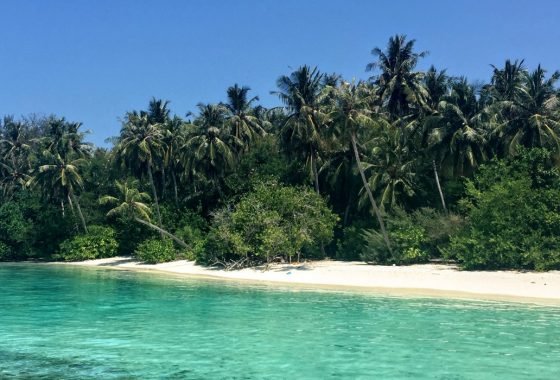
The panorama, which was now spread out before us, was beautiful in the extreme.
The low shore, marked by the thin white line of the beach, was covered to
the height of about seven feet with a thick growth of jungle, above which
waved the graceful heads of thousands of coconut trees, to which the slight
breeze then blowing imparted a scarcely perceptible motion.
As
I leant over the bulwarks, admiring the scene, I suddenly became aware of
a painfully pestilential odour, which at once dissipated the romantic thoughts,
which the beauty of the scene had conjured up. This was the much dreaded
fever-laden breath of the lagoons, the cause of the deadly Maldive fever.
This
stench is due to a peculiarity in the atolls, or clusters of islands and
reefs which constitute the Maldive group. Most atolls are formed of a circle
of islands, connected by reefs, which enclose a large tract of water, or
lagoon, with depths varying from 10 to 40 fathoms, forming good anchoring
places for ships which can enter through passages in the barrier reefs.
Most
of the islands are small, varying from a hundred yards to a mile in length
and breadth, and are seldom more than six feet above the level of the sea.
In many cases the islands form part of a ring of coral rock without any
opening, the consequence being that when the sea is calm, the enclosed water
becomes rapidly putrid under the action of sun's rays, and emits the odours
to which I have referred. Indeed, many of the islands are quite uninhabitable,
owing to the coral ring having grown to a height sufficient to exclude any
but the highest waves; others, again, are only unhealthy during the hot
season, the outside sea being able to beat over the barrier during the time
that the south-west monsoon is blowing, and thus to constantly renew the
water within.
I discovered afterwards that the lagoons which
emitted the odours did not affect the town, or island of Male', and that,
with a few exceptions, the danger was very much smaller in October and November
– that is, just after the north-east monsoon had set in – than in March
and April.
|

Maldives flag in 1885 Rosset
mistook this as the flag of the Ottoman Empire, according to Maldivian
historian Majid Abdul-Wahhab.
|
When we had arrived within five hundred yards of the shore, the Turkish
flag, which floated from the flagstaff in the northern corner of the old
Portuguese fort, was lowered in salute. The Ceylon returning the
compliment by dipping her ensign three times.
Illustrierte
Zeitung: 'The town of the sultan is protected by an old and
useless fort, that is armed with many worn out and rusty old guns.'
The
anchor was dropped shortly afterwards, at about 250 yards from the beach,
as foreign vessels are not allowed to enter the harbour of Male' without
having first obtained the sultan's permission. The sight of the
steamer had by this time attracted crowds to the beach, and it seemed as
if the entire population of Male' had turned out. About half-an-hour after
the anchor had been dropped a large canoe could be seen issuing from the
harbour; it was propelled by 40 rowers, and was soon alongside.
It
conveyed the messengers from the sultan, who were sent to inquire what business
had brought us there, and I at once handed them the letters of introduction
with which I had been furnished in Ceylon before my departure, at the same
time expressing my wish to be conducted as soon as possible to the prime
minister, E. A. Abrahim Deedee, to whom I had been specially recommended.
One of the messengers, named Ibrahim Deedee (who, I was glad to discover,
was able to speak a little English) told me that if I returned with them
to the shore my request could be immediately complied with, and I accordingly
entered the canoe with them. The passage through the surf in these
boats is at times a matter of danger. They are built of a length quite out
of proportion to their breadth, which makes them very unseaworthy, and to
add to the discomforts of the passenger he is obliged to stand up in the
stern, as no seats are provided for his accommodation, so that unless he
keeps a very sharp look-out he runs considerable risk of being shot overboard
when the stern is lifted by a wave, in which case no power on earth could
save him unless he happened to be a very expert swimmer.
The
boatmen themselves, being as much at home in the water as on land, are naturally
indifferent to the danger; in fact, they are well used to being ducked,
as at certain times of the year they are almost certain to be capsized during
the passage. However, on this occasion the surf was moderate, although sufficiently
alarming for a novice, and I was assured that there was not the slightest
risk of an upset. As I stepped ashore the vizier came forward,
and taking me by the hand, led me away at once through the principal streets
of the town. Close behind us walked my two Singalese servants, dressed in
a gala costume of red satin, whilst a crowd of inquisitive Maldivians brought
up the rear, forming a procession of quite respectable length.
 Wood carvers, Male', Maldives 1885 Photo by C. W. Rosset |
We soon arrived before the entrance of a large compound surrounded
by a high wall, in the centre of which stood a small building, which I afterwards
discovered to be the Kacheri (answering to the Town Hall of a European
town), which I was invited to enter. The entrance, destitute of any door,
was very low, and it was necessary to stoop nearly double in order to penetrate
to the interior, which was so dark as to make it impossible to distinguish
anything for several minutes after leaving the fierce glare without.
A
seat was offered me, and accepted, and four individuals, whose dress bespoke
them as persons of rank, took their places, two on either hand. Not a word
had yet been spoken since I landed, and the silence continued unbroken for
several minutes after we were seated. I tried to make out what my companions
were like, but the semi-obscurity of the apartment rendered their features
very indistinct; so far as I could make out they appeared to have regular
features, and that tranquil expression usually found in orientals. No two
of them seemed to be of the same colour; one was quite fair, the second
darker, while the third and fourth had complexions which approached a mahogany
tint. The silence at length began to get irksome, and I therefore
inquired of the messenger whether I should soon be able to speak with the
prime minister. He replied that his excellency was then seated on my right.
I at once addressed myself to him, and, after naming different gentlemen
in Ceylon who had sent complimentary messages to him, made my request for
an audience of the sultan, adding a few words touching the object of my
visit.
He inquired whether I had any letters for his majesty
the 'sultan and king', to which I replied in the negative. I had been advised
in Ceylon not to take letters for the sultan, who can neither read nor write,
and with whom it is advisable to have as little direct intercourse as possible,
he being very averse to Europeans.
Illustrierte
Zeitung: 'Later I found out that this negligence of his person
made the sultan very sour.'
In requesting the
interview with the sultan, I further asked for permission to make a lengthened
stay in the islands, and to be allowed to build houses, collect specimens,
and travel from one island to the other through the group.
The
minister departed to carry my requests to the sultan, and returned in about
half an hour. He informed me that the sultan would be unable to reply to
my request for an audience for eight or ten days; that he could not give
me any answer touching my wish to travel about the group; but that instructions
had meantime been given for houses to be placed at my disposal, and for
any provisions I might require to be supplied.
This was exactly
the answer I had expected, and I was about to express my thanks and withdraw,
when Abrahim Deedee informed me that if I desired it I could have the use
of a house and compound belonging to him, which, being on the shore of the
harbour, would be much more convenient than one in the centre of the town.
I gladly accepted this kind offer, and after thanking him took my
leave, as I wanted to return on board and get my boxes (of which I had 45)
ashore before night. The natives gave every assistance, and the work was
accomplished in good time, and I was able to return on board before sundown,
leaving my two servants to arrange the house which had been set apart for
my use.
The next morning I bade 'good-bye' to my friends captain
Wilding and the officers of the Ceylon, and went ashore in the
native boat which had been sent off for me. A stiff breeze had sprung up
during the night, and the high sea then running made the short passage to
the beach very trying, whilst the rain which was pouring down added to the
discomfort; so that I was very glad when the beach was at length gained
in safety, in time for a last look at the Ceylon, which was steaming
off in the direction of Minicoy.
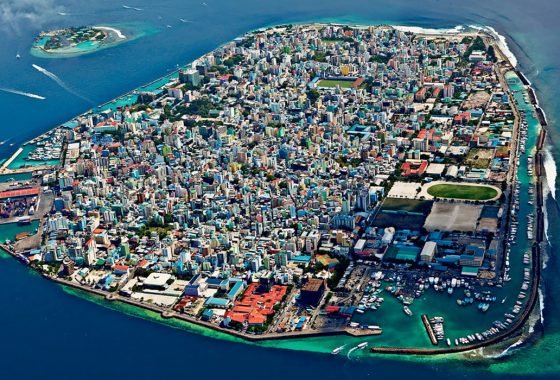
Male' (or Sultan's island)
is situated at the south-eastern corner of North Male' atoll, and is the
seat of government of the group. It is about a mile in length by three-quarters
in breadth, and, like most of the other islands, is in no place more than
from six to seven feet above the sea level.
The harbour has been
formed from a part of the lagoon enclosed by a barrier reef which nearly
surrounds the island, and on which a kind of the sea wall about four feet
high has been built with rough blocks of coral. The harbour thus formed
affords very efficient protection to the Maldivian trading boats (daturu
odi) and fishing boats (mas odi): but the entrance is too
narrow for vessels of more than 200 tons to enter.
Illustrierte
Zeitung: 'Concerning the climate of Maldives, it is not so
good, particularly on Male' atoll. Almost all Europeans who, by different
shipwrecks, have landed on these islands, have died there from fever (Malaria).
During my stay in the islands, up to 60% of the natives were sick with fever,
of course due to the unhealthy season. (The N. E. monsoon is the best weather.)
Due
to always maintaining a good diet, and my experiences from nine years of
travelling in Africa, India, Arabia and similar places, I have always managed
to stay healthy, even though I have been in daily contact with sick persons.'
The town of Male' struck me as being more regularly laid out and
cleaner than is generally the case in Eastern countries. The streets are
straight, broad, and shaded with trees, and are kept very clean.
The houses are mostly built of plaited coconut leaves plastered over with
a stiff mud, and roofed with coconut leaf thatch; they are usually divided
into two apartments, communicating by a doorway closed by a curtain. The
front apartment is the general and sleeping room, and is furnished with
benches round the wall and a few stools beside the bed, which is always
the most conspicuous article of furniture in a Maldive house. This bed is
suspended from the roof by chains or rope, the material of which depends
upon the caste to which the proprietor belongs; high castes using brass
chains, middle castes iron chains, and low castes coir ropes. Legs are also
provided in order that the bed may be lowered down in case of illness, when
the swinging motion to which it is liable would be a source of danger or
annoyance to the patient.
The furniture of the bed is a matter
of great importance; high castes use a mattress and pillows of red silk;
middle castes are content with cotton stuff; while low castes sleep on straw.
The mattress or straw is covered with a mat, the pattern and quality of
which are regulated by the caste of the owner. The Maldivians display great
skill and taste in the manufacture of these mats, which have acquired reputation
for harmonious design and permanency of colour. They are made only in Suvadiva
atoll from a grass called by the Maldivians hau; only three colours
are used - black, dark yellow, and white, which are obtained from plants
and are wonderfully lasting. A good idea of the ordinary appearance of a
high caste bed can be got from the illustration representing the reception
room of a high caste.
Although the Maldivians keep their houses
scrupulously clean, they are very unhealthy on account of being surrounded
by a wall from six to seven feet in height, which impede the free passage
of fresh air, this being all the more hurtful as the openings which serve
the purpose of doors and windows are not very large. The bad effects of
this arrangement are apparent in cases of illness, when the patient as often
as not dies as much from want of fresh air as any other cause.
Illustrierte
Zeitung: 'Male' has about 800 single storey houses. The house
I lived in, the one that the minister had supplied me with, was one of the
few with an upper floor. In this house I used the lower rooms as a store.
The house is 10 metres high, the bottom level is 3 metres, the upper level
is 4 metres, and the roof is 3 metres.
The house stands on six
to ten coconut palm logs around 40 cm. thick. The external walls are covered
with 20 cm. wide wooden planks made of magu dandi, and it is also
used as flooring board. For the roof covering and the second floor, they
use a more delicate wood called dumbury.
The ceiling
and the external walls of the ordinary houses are covered with water-proof
coconut palm leaf mats, fangandu. The door entrance has no enclosure.
An opening, about one square metre, on the second floor serves as a window,
with a sliding curtain/mat made of coconut palm leaves.
The houses
are in gardens and these are fenced in. The interior of the houses is divided
into two parts, one for the men and the other for the women and children.
Both are equipped with suspension beds. The women's part of the room also
has a swing, called aendu.'
The inner
compartment of the house is reserved for the women, who remain there when
not engaged in household or other duties, or when male visitors are in the
house. They are not, however, secluded with the same strictness as is observed
in other Mohammedan countries; on several occasions when I was visiting
at some of the lower caste houses the women of the household would join
in the conversation, though always remaining invisible in their apartment.
The remains of the fort erected by the Portuguese during one of the temporary
occupations of the islands probably in the 16th century would seem to indicate
that they looked upon the Maldive islands as a position of considerable
importance. In my view of Male' harbour it will be seen that the main bastion
is a structure of great strength; the walls of solid masonry are upwards
of 20 feet in height and in a good state of preservation, though much overgrown
with weeds and grass.
Many of the old cannon are lying about
within the fort; but are, of course, quite useless, being rusty, and choked
with coral. A mast from a ship wrecked some 200 years back is raised in
a corner of the bastion and serves as a flag-staff. Scattered about the
town are upwards of 200 old cannon, all as unserviceable as those in the
fort.
 Lithograph of photo by C. W. Rosset, 1885 |
The sultan's palace is situated to the north-east of the main bastion,
in the centre of a large walled enclosure; before the gateway are placed
about half a dozen old cannon, the only ones capable of being used, with
which salutes are fired on great occasions. The palace itself is a large
building with an upper floor. Visitors are received in the verandah which
I was able to photograph.
Illustrierte
Zeitung: 'The sultan's residence is walled in by high stonework,
and at its corners and its entrance gateway, European iron lanterns are
standing, which give light by burning coconut oil during the dark nights.
Inside the stone walls are: 1. The palace built in European style; 2.
One big tent without sidecovers, where there is room for the sultan's 150-200
dancers and musicians to perform their show; 3. The sultan's private
house, also in the European style, built with a nice verandah, and containing
expensive European furniture.
On this verandah I saw the instruments
of the sultan's musicians, I even found many a name of various Dutchmen
and Portuguese. In the private room of the sultan there are one door and
four windows with red silk curtains. The windows are well-fitted with iron
bars. Behind these curtains the beautiful heads of different women, with
big black eyes and lustrous necklaces peeped out, and red, gold, and silver
embroidered satin walls came in sight. The head of the sultan was usually
in the door-opening. The women of the superior caste are the most beautiful.'
François Pyrard de Laval, a French adventurer who visited these islands
during his travels in the east early in the 17th century, and was detained
here for five years from 1602 to 1607, gives a long and minute account of
the palace, according to which it contained many fine halls tastefully decorated;
but during my stay I was unable to penetrate within, and cannot therefore
either confirm or amend his description.
Within the palace enclosure
are several buildings used as stores, and an arena in which the dances and
sports take place, on one side of which is a kind of raised covered platform
for the accommodation of the ladies of the court and some of the hired functionaries.
There are several mosques in Male', two of them larger than the others;
but they offered no peculiarity either of structure or ornament which would
entitle them to special notice. Male' being the centre of the government
and trade of the whole group, is naturally the most thickly populated, and
as the Maldivians not only invariably bury people where they die, but are
also very careful not to inter two in the same place, some idea can be formed
of the number of graves to be seen there. This has been advanced as a reason
for the unhealthiness of Male', and I think that the water drawn from the
wells must inevitably be contaminated.
A graveyard in Male', Maldives Photo
by C. W. Rosset, 1885 |
The Maldivians differ somewhat from other Mohammedan peoples in their
manner of burial; the mourners as a rule follow the corpse in silence and,
except involuntarily, do not give audible expression to their grief. Six
of the near relations of the deceased act as chief mourners, and bear the
body wrapped in white linen on a bier of candou-wood (M. kadu)
to the place of interment, where it is received by the priests, who chant
a sort of monotonous dirge during the ceremony.
On the way to
the burial place, two or three of the relatives of the deceased sprinkle
the processionists with perfumed water, and also distribute rice and cowries
to the poor. The grave is generally about four feet deep, and when the body
has been laid in it, with the face turned towards Mohammed's tomb, it is
filled up with clean white sand, and perfumed water sprinkled over it. A
stone is erected over the grave, varying in shape and size according to
the sex and caste of the deceased, and a wooden fence is also generally
added to prevent anyone from walking over the grave, which is considered
a great sacrilege by the Maldivians.
 'Grave of a high caste in Male' Photo by C. W. Rosset, 1885 |
No period of mourning is observed, except that the near relatives
come on the three following Fridays to pray at the grave. The priests receive
as a fee the cotton cloth in which the body is wrapped, and pieces of money
according to the rank and wealth of the deceased. Pyrard says that when
a 'great lord' dies the priests sing over the grave for one year; in the
case of a sultan dying, the ceremony is continued until the death of his
successor. The ordinary dress of the men is very simple, consisting
of drawers, a cloth bound round the loins, after the mode of the Singalese,
and a handkerchief twisted round the head. On special days, such as Fridays,
when they attend the mosque, the high caste wear a shirt and jacket, over
which is a kind of long dressing down, coming down and nearly to the feet.
The turban is only worn by priests and the sultan.
Illustrierte
Zeitung: 'Most of the time the Maldive men walk around half
naked, and only when ordered by the sultan at celebrations do they change
into their Arab dresses with their caste designations. The main food intake
for the superior people is birds, the poorer mostly eat fish, and to be
a fisherman in the Maldives is a fine labour. Vegetables are brought from
abroad. All food is cooked with curry. The only fruits available are coconuts
and bananas. Lemons, melons and oranges are only to be seen in the sultan's
garden.'
Maldivian girl on swing
in Male' Photo by C. W. Rosset, 1885 |
The women's costume is exceedingly becoming. Round the waist, and
reaching down to the ankles, is worn a cloth (mostly of native manufacture),
coarse in texture, of a dark chocolate colour, with a border of parallel
black and white stripes. Over this they wear a kind of loose shirt, or gown,
of silk, with short sleeves, reaching nearly to the knees, which is not
made to fit to the neck and shoulders, but is gathered in round them; the
openings for the neck and arms are ornamented with embroidery in gold, silver,
and silk thread.
The hair, which is black, and generally long
and thick, is tied up behind, and a handkerchief of the same colour as the
shirt is bound round it. All ranks wear a similar costume, the distinctions
of caste being marked by the difference in the quality of the silk stuff
of which the shirt is made, and of the embroidery.
People in Male' 1885 Lithograph
from photo by C. W. Rosset |
The Maldivians are very quiet and reserved in their intercourse with
foreigners until their confidence has been gained, when they show themselves
hospitable to a degree. They have few wants, and as they possess the means
of easily satisfying them, are inclined to be indolent; sober, honest, and
cheerful, they compare favourably with the inhabitants of many other Eastern
countries.
They are very ingenious and expert in their manufactures,
and display great aptitude in the imitation of any European articles they
may come across, such as knife handles, scales, and other small articles
of daily use amongst us.
Illustrierte
Zeitung: 'The inhabitants of Maldives are a mixture of different
races. Arabs, who are the first and main population, Singalese from Ceylon,
and Malabars from India. The language is related to Arabic and Singalese.
The powerful and rich people understand Arabic. The whole population numbers
150,000 persons.
Only the prime minister and his two nephews
Ibrahim Didi and Ali Didi speak fluent English. The Maldive people are by
religion Mohammedans, and the sultan is very devoted. Strangely enough,
they also believe in a Devil, whom they blame for all disasters.'
The
sultan is a young man of some three and twenty years of age, strongly built,
and with a well-proportioned figure. His complexion is fair, and his regular
features are well set off by a jet black beard, worn short, as is the custom
among Maldivian high castes. He is of a very full habit of body, and the
life he leads is such as to preclude any possibility of his life being a
long one.
His rule is absolute; and although he has ministers
whose advice he seeks on any occasion of importance, he seldom if ever profits
by their wisdom, and often takes the course directly opposite to their views.
He
is very adverse to any intercourse with foreigners, especially Europeans,
whom he either refuses to see at all or keeps waiting, perhaps, for weeks
before granting an interview. At the time of my visit, this cautiousness
had been very much increased by the recent arrival of news from Zanzibar,
giving details of the doings of the Germans in that part, and he consequently
fancied that my visit had some ulterior and political design which he could
only frustrate by detaining me in Male' until the Ceylon arrived
to take me away again. Fortunately for me, his ministers were not so prejudiced
as their master, and gladly gave me all the assistance they dared in face
of the restrictions put upon them by the sultan.
It is fortunate
for this monarch that he has had to deal with the English for the last century,
also that his dominions are a little out of the direct march of civilisation.
But the time cannot be far off when his only choice will lie between submission
to the Europeans or practical effacement.
Illustrierte Zeitung: 'It was very difficult for
me to meet the sultan. In an audience, I did not succeed in getting any
permission from him to go and visit other Maldive islands. He took me for
being a German agent, who was sent here to work among his people for a German
annexation. I met the sultan only twice.
He is a big stout person
who suffers from adiposty [obesity], has a light brown face colour and a
black short full beard. He is about 22 or 23 years old, but a stranger would
judge him ten years older. He calls himself 'the sultan of 13 atolls and
12,000 islands', and his country has English protection. He has a great
power over his subjects and demands to be addressed 'his royal highness'.
Without his permission they were not allowed to have anything to do with
strangers, and neither to buy or sell anything to them.
The sultan
was in possession of several valuable artifacts, like spears, swords, shields,
and musical instruments, but it was impossible for me to get hold of any
of these. Not counting all the other gifts, I offered the sultan an excellent
shooting gun with leather cover in exchange. But he did not enter into the
bargain. Instead he wanted to buy my gun. I have noticed that if you want
some items from the Maldivians, it is not advisable to offer them any money.
Thereby you appear in their eyes as some businessman or trader and will
be treated as such a person. Moreover, the sultan has no manners at all,
has never been in contact with Europeans, and is not able to read the Holy
Koran.'
Although not so strict as formerly, caste
distinctions are rigidly adhered to. The sultan naturally occupies the highest
rank, after him come his near relations, who have the sole right of assuming
the title of Mannipul or Manifulloo; the next in rank
are the descendants of former sultans, who have a right to assume the name
and rank of Didi, or Deedee.
When the sultan
appoints a minister, or wishes to show any particular favour, he bestows
a title, which has generally attached to it the ownership of certain islands,
which become either the life property of the favoured person, or else are
held by him during the sultan's pleasure. The present ministers, with their
titles and in order of rank, are: Manifulloo, title Fatina
Kilage-fanu, Treasurer: he is a near relative of the sultan, to whom
he is next in rank; but he has very little influence over the monarch, hardly
more than other high castes.
Hassan Deedee (left)
and Abrahim Deedee, prime minister of Maldives Lithograph
from photo by C. W. Rosset, 1885 |
E.A. Abrahim Deedee, title Dorimaina Kilage-fanu, prime
minister: Abrahim Deedee is undoubtedly the most enlightened of all
the sultan's subjects. To him is entrusted the management of the trade of
the Maldives, which already shows signs of development in spite of the restrictions
with which the sultan hampers it.
He is a great friend of the
English and spent some years in Ceylon, acting as Turkish consul in Galle,
an office now filled by his son. It is to him that I owe the success of
my first visit. I always found him ready to give me every assistance and
information in his power.
Illustrierte
Zeitung: '[Because of the sultan's illiteracy and inexperience
with Europeans] he is forced to hand over all official government decisions
to his prime minister A. Ebrahim Didi, or the Maldivian Dorimaina Kilegefanu,
the only Maldivian who has had European education from schools in India
and Ceylon.
He speaks seven different languages, is intelligent,
stable and very loveable person. He has copied the English system and introduced
an organisation for taxation of imports and exports. The sultan does not
like this new system, and most of all he would like to dispose of his minister,
but he is not able to govern the land without him.'
The minister
helped me in my efforts to collect Maldive ethnographical material. Without
the sultan's permission he sent out sailing boats to other islands, in order
to get information and artefacts for me. Besides this, the sultan supported
his subjects to give me four-footed animals and lizards, as he enjoyed seeing
them prepared in glass bowls.
I was also given permission to
make photographic pictures, and the sultan showed that he was pleased to
see the photos I had made. I gave him a picture of myself, but he hesitated
when I wanted to have a photo of himself. He showed an interest in my European
civil uniform as he had never seen anything like it.'
Hassan
Deedee, title Famu Dairi Kilage-fanu: Hassan Deedee is a cousin
of E.A. Abrahim Deedee, and has the command of the army; his principal duty
being to superintend the fencing and dancing games which are held periodically
by order of the sultan. One interesting fact in connection with him is that
he is the only Maldivian man who is allowed to wear the old Maldive costume,
in which he was dressed when I took his photograph. This costume nearly
resembles that worn by the women of the present day.
A. Mohamedu
Deedee, title Rana Badari Kilage-fanu.
Next in rank
to the ministers are the viziers, or Mouscouly, who have charge
of the divisions, or wards, into which Male' is divided (called Avari),
of which there are four. There are other titles bestowed by the sultan which
are merely social distinctions, and many of which can be obtained by payment
of a few rupees. The trade of the Maldives must all pass through
in Male' and is mostly carried on on the principle of barter. The bazaar
in Male' is the only one which exists in the group, and it is here that
all the foreign trade is carried on. The shops are the personal property
of the sultan, who lets them out to a number of Bombay merchants, at rents
varying from 15 rupees to 50 rupees per month. These Bombay merchants mostly
sell rice and cotton goods to the natives, taking in exchange tortoise-shell,
coconuts, cowries, and dried fish.
A man's caste is dependent
on that of his mother, whose station is not affected by marriage. I was
not able to find out how many castes are in existence; but believe that
the number is about seven or eight. The high castes include the first three,
and have the sole right of furnishing soldiers and dancers of the sultan;
the lowest castes are the toddy-drawers (M. Ra-veri). When two
people of different castes meet, the lower caste makes way for the higher
caste; in company the lower caste remains standing until invited to be seated
by his superior, and waits till the latter has finished his meal before
commencing to eat.
Illustrierte Zeitung:
'The nobility and rich people of Male' came every day to visit me in my
house, they observed me curiously in my scientific occupations, and listened
with great interest to me when I told them about Europe. Specifically they
wanted to hear about Germany and the German warships' activity at Zanzibar.
They had already been informed about this by merchants from Zanzibar. They
showed the greatest respect for the German presence. They paid much reverence
to the German Kaiser and his Kansler Bismarck.'
| |
Tuttu Siddi Lebbe, a Mohammedan
priest, and his son Lithograph from photo by C. W.
Rosset, 1885
|
The Maldivians are Mohammedans, and it is generally supposed
that their conversion to the faith of the Prophet took place some seven
hundred years back. Although particular in observing the fast and ceremonies
of the religion, they are not so particular as to the manner in which this
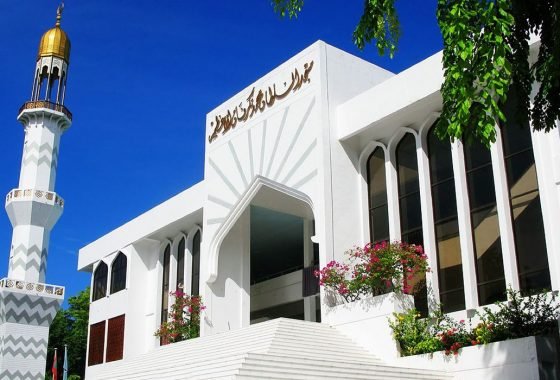
is done. Their mosques are well built and kept very clean; and there are
several in Male', but one is mostly used for ordinary festivals and prayer,
and is called the Friday Mosque (M. Hukuru Miskitu).
Superstitions exercise a great influence on the daily life of the Maldivians,
much more than religion. They are principally afraid of the Devil, who is
supposed to exercise great power, and whom they make responsible for all
mishaps which befall them; they go out at night very unwillingly, for fear
of meeting him. Should illness visit a house, it is supposed that the inmates
have offended his satanic majesty in some way, and prayers are addressed
to him, begging him to cease the supposed punishment; in extreme cases these
prayers are written on a piece of cotton stuff stretched on a small wooden
frame, which is exposed before the house.
Illustrierte
Zeitung: 'The Maldive people are friendly and hospitable. They
helped me when I was disembarking and moving my luggage ashore, and they
helped me in my collecting activities. The young people gladly gave help
using a roll-call system. The Maldive people are anxiously curious, the
first days of my stay they besieged my house, and in the streets hundreds
of them followed me. When I was called to some house, they wanted medical
help, to get quinine, opium pills, castor seed oil and other medicines for
the sick. Sometimes it was just out of curiosity that they asked me to come
in.' The Maldivians do not marry very early; I
believe the usual age for men is between 18 and 20. Polygamy is allowed,
according to the Mohammedan law, the number of a wives being limited to
four. The ceremony is extremely simple: the man having satisfied the parents
of his intended bride of his ability to support her, the pair attend before
the magistrate of their island, and signify their mutual wish to be joined
in matrimony. The magistrate thereupon declares them to be man and wife,
calling upon those assembled to be witnesses. It will readily be understood
that a bond so lightly tied can be as easily severed; should a couple not
agree, they attend again before the magistrate, who, after satisfying himself
that both parties desire the separation, declares the marriage annulled.
The amusements are very few; indeed the islanders are of too indolent
and taciturn a disposition to enter with spirit into any pastime. Fishing
is their favourite exercise, and is indulged in to nearly the same degree
as hunting and shooting in England. They are fond of kite-flying; but this
pastime is only permitted at certain periods of the year.
For indoor
games they have chess and a species of 'fox and geese' played with nine
cowrie shells on a board marked out into regular spaces.
On
special occasions organised sports are held, which are generally witnessed
by the sultan and his wives. At these sports the young men generally engage,
two at a time, in a kind of fencing exercise with sticks; which is, however,
entirely without interest. The two principal games or dances are the Malikutara
and the Todu.
Malikutarra drumming dance Lithograph
from photo by C. W. Rosset, 1885 |
The first came from Minicoy (hence its name), and is performed by
about 20 tom-tom beaters, who go through a series of slow movements, accompanying
their gestures by a regular thumping of their instruments.
Lithograph from photo by C. W.
Rosset, 1885 |
The second game is of pure Maldive origin; it originated in Ari atoll,
and is performed by about six couples of fencers, armed with wands some
six feet long, to the ends of which are fixed metal boxes filled with cowries,
resembling the children's rattles in Europe. With these they go through
a series of movements, timed to the regular beat of tom-toms, and by striking
the wands against one another, make a continuous rattling noise.
 Lithograph from photo by C. W. Rosset, 1885 |
The private band of the sultan is not without interest. It plays before
the sultan on special occasions, and sometimes in public. The instruments
date from the time of the Portuguese or Dutch. I heard a performance, but
cannot say I was able to make much of the music; it reminded me at times
of some airs which I have heard in Arabia. The leader had a large open book
before him, which I asked to be allowed to see, thinking it would afford
me some information on the subject; but it only contained a few Arabic characters,
not bearing in any way upon the subject of music.
 Young Maldivian woman wearing traditional late 19th century dress with bangles Photo by C. W. Rosset, 1885
|
|
The Maldive women are very fond of ornaments, and all wear quantities of rings,
brooches, earrings, necklaces, and bangles, which are made either of gold,
silver, or brass according to the caste of the wearer. In former times all
the jewellers were inhabitants of Nilandu atoll, and travelled from island
to island throughout the group, remaining on each as lang as employment
offered; they are now, however, permanently established on most of the principal
islands. The laws regulating what ornaments the women should use were much
more strict formerly than now; at the present day a women may wear what
she can afford to buy, whatever her caste may be. The embroidery work produced
by the women is remarkable for neat workmanship and tasteful arrangement
of the colours used.
As in all Eastern countries, all household
duties are left to the women, who also have to prepare and cook their husbands'
food. They are not allowed to eat with their husbands; but must first wait
upon him until his meal has finished, when they retire to their own apartment
for their repast. As rule they are decidedly handsome, and many of them
have complexions nearly as fair as the women of southern Europe.
They
are better treated than in other Mohammedan countries, having a great deal
of liberty. They never veil their faces, and the only restriction to which
they are subjected is that they are not allowed out at night, which is not
any great hardship for them, as the fear of meeting the devil is already
a sufficient inducement for them to remain at home.
Illustrierte
Zeitung: 'The 29th of November (Friday), the sultan gave me
permission, after my asking, to take photos of the musicians and the dancers.
This permission gave me access to his private apartment, and thereby he
and especially his wives could have a closer look at me.
The
Maldive women seemed very shy, when I was called in to their different homes,
to give them medical help. In the beginning I had to stand in front of the
house's room curtain, that separated the men's and women's space for each
other, when I was to examine the woman. At once there were six to ten hands
sticking out from the drapery, when I wanted to find out the heart-pulse.
Whoever the arm belonged to I did not know, as I never saw the women behind
the curtain.
After some time, the women became more open and
associable, as they got acquainted to my information and approaches, and
I was able to examine them properly.' Crime
is very rare on the islands, and the punishment inflicted would generally
be considered mild in Europe. Death is never inflicted, the severest penalty
being banishment to an uninhabited island for a period commensurate with
the offence committed. The commonest punishment is castigation, the blows
being dealt on the back and thighs with a sheet of leather inserted into
a handle.
During my stay a man and woman who had killed their
new-born child - the commonest crime in the Maldives - were sentenced to
castigation and banishment for life. The woman was the first to receive
punishment, and I had an opportunity of witnessing the infliction.
She
was conducted through the principal streets of the town securely bound with
strong cords, which were firmly held by two men on either side. Her face
was smeared with black and white paint, and a coconut leaf fixed to her
back stood up about six feet above her head. Tom-tom beaters marched 20
paces ahead of the procession, and called upon the people to come out and
witness the punishment. At about every 200 yards a halt was made, and a
strongly built Maldivian administered between 30 and 40 blows with the leather
instrument described above. This was repeated until the whole town had been
traversed.
Next day came the man's turn, and then both were banished
to separate islands for the rest of their days.
The punishment
here described was inflicted with the plain leather, which I should say
was not capable of inflicting much pain; but I was informed that when the
punishment is intended to be very severe iron nails are inserted in the
leather, which cruelly lacerate the flesh; this must be of very rare occurrence,
however. I was unable to go further than the island of Male'
on this visit, as the sultan (who suspected I had some ulterior political
design in visiting his country) refused to allow me to proceed further.
When he ultimately gave his consent it was too late, as the Ceylon
was then due to take me back to Colombo, and as I had arranged to exhibit
my collection at the Colonial and Indian exhibition, further delay was impossible.
I intend, however, to revisit the Maldives before the close of the year,
to complete the explorations begun in Male'.
Illustrierte
Zeitung: 'The information I was able to get about the other
Maldive islands from the natives, I do not consider reliable. I plan to
go back to the Maldives this year, and then visit the other islands. The
sultan is hopefully not going to make any obstructions. His minister was
informed by the captain of the steamer, which came on the 21st of December
to take me back to Ceylon, that my journey to the Maldive islands was entirely
done for scientific reasons.'
C. W. R.
N.B.:
In this connection the Laccadive Islands may be mentioned. They lie to the
north of the Maldive group, and may be regarded as a continuation of the
same island system. The Laccadives lie chiefly between lat. 10 deg. and
12 deg. N., and long. 72 deg. and 74 deg. E., about 75 miles from the Malabar
coast.
There are 19 principal islands, but the largest (Anderov)
is not more than six square miles in extent. Most of them are surrounded
by rocks and coral reefs: the water near them, however, is deep, and they
are separated by several wide channels, frequented by ships passing from
India to Persia and Arabia.
They are inhabited by a race of Mohammedans
called Moplays. They do not yield grain, but produce an infinite quantity
of coconuts, from the husks of which coir cables are made by the inhabitants.
These islands are well supplied with fish, and export the small shells called
cowries, which pass as coin all over India.
Jaghery, a little
betel-nut, plaintains, a few eggs and poultry, and coral for conversion
into lime are their remaining exports, but they are of little importance.
The Laccadive islands were discovered by Vasco de Gama in 1498: they were
dependent on Cannanore till ceded by Tippoo in 1792, when they came into
British possession with the rest of that sovereign's dominions.
Comments on Rosset's 1885 visit by Maldivian royal family
historian Majid Abdul-Wahhab: King Ibrahim Nooreddine Iskander,
unlike the rest of his family and extended family, was reputed to be extremely
dark in complexion. Rosset visited the Maldives during his first reign (1882-86).
Until
his second reign (1888-92), the Islamic mullahs prevented the Maldive kings
from giving audiences to Europeans. They were afraid of the kings being
persuaded to accept Christianity, as one did in the 16th century.
Visiting
Europeans who requested audiences were always made to meet a commoner dressed
as the king. Rosset described him as fair in complexion indicating that
he had been shown someone else.
Ibrahim Nooreddine Iskander was
my great-grandfather's younger brother. The king was young, educated and
very progressive in his ideas. This was all the more reason for the mullahs
to keep control over him.
His daughter the Princess Don Goma
wrote a book over many decades that was not flattering in its descriptions
of the schemes of those who wielded control in the Maldives. The manuscript
of Don Goma's book, which was never allowed to be published, was seized
from her grandchildren in the 1980s and destroyed by the government.
Following political upheaval in Male' in 1887, Athireegey Ibrahim Didi Dorhimeyna
Kilegefan (whom Rosset calls E.A. Abrahim Deedee) was dismissed as
prime minister. A serious arson campaign including burning down houses and
business premises of government and ordinary citizens ensued. The ex-prime
minister was implicated and charged. Subsequently he was freed,
following intervention by the British authorities in Colombo.
Athireegey Ibrahim Didi regained power more than once and kept it after
1903. He died in 1925 following a stroke.
|
|