|
|
Scripts of Maldives Naseema Mohamed from Essays on Early Maldives
National Centre of Linguistic and Historical Research
(NCLHR) Male', Maldives 2004
Introduction
Ancient Maldives was known by many different names, among them Mahiladvipika,
Diva Mahal, Maldiva and the Cowrie Islands, but the traditional name for these
islands is Dhivehi Raajje, the inhabitants are Dhivehin, and their language is
Dhivehi.
The Dhivehi civilization dates back more than two thousand
years. Cowrie shells from the Maldives travelled the ancient world, from Africa
and the Middle East to South East Asia and China. If the history of the ancient
Maldivian cowrie shell trade could be traced, historians could perhaps go back
even further in time. The identity of the first settlers in the archipelago remains
unknown, but the language and old place-names show Aryan and Dravidian origins,
suggesting early migrations from the Indian subcontinent.
The Dhivehi
people built places of worship out of coral stone, cutting the blocks and fitting
them together with amazing mastery. Regrettably, all that exists now of the oldest
of these buildings are only the foundations, or at most, only the lower parts
of what must once have been strong edifices. What existed of the old structures
have been covered with the soil and vegetation of the passing centuries, so that
these places now exist in the form of mounds or gentle hillocks, still to be seen
in many islands of the Maldives.
The history of writing in these islands
is more than 1400 years old. Inscriptions have been found on some of the artifacts
discovered at heritage sites and on artifacts unearthed in various islands. The
Dhivehi scribes of long ago carved their inscriptions on soft coral, probably
using a metal instrument. The coral stone inscriptions that have been found are
religious mantras of the Vajrayana Buddhist sect; the earliest is dated to the
6th century AD.
In Dhivehi, letters of an alphabet are called akuru,
the word originating from the Sanskrit akshara or from the Pali akkhara.
Three main scripts or akuru were used in Maldives over different periods
of history. These were Eveyla, Dhives and Thaana. Until
the late 18th century AD, Dhivehi was written in a script that had strong similarities
to South Asian scripts such as Grantha, Elu and Vatteluttu.
Although there were differences between earlier and later forms of the letters
used in Maldivian writing, Dhivehin (Maldivians) called the old scripts Dhivehi
or Dhives Akuru, literally meaning 'letters of island people'.
Ancient Scripts A recently
discovered inscription from the Maabudhuge archeological site, on the island of
Landhoo in South Miladhunmadulu Atoll, is now thought to be the oldest script
found in Maldives. The letters are inscribed on four sides of a block of coral,
in a version of the Southern Brahmi script of the Pallava period, estimated to
date back to the 6th century AD (shown below).
The
inscription is a mantra of Vajrayana Buddhism, a form of Buddhism that had existed
in Maldives in ancient times.(Gippert 2003). The stone may have been buried in
the foundation of a religious building to ensure safety from evil spirits, a practice
known to have been used during the pre-Islamic period. The letters show some resemblance
to the later Eveyla Akuru leading to the theory that this early script may have
played a part in the formation of the first known Dhivehi alphabet.
Some letters
of this script are similar to letters inscribed on relics found in 1962 in Aifaanu Magu in Male'. Another palaeographically datable legend was inscribed on the cover of a coral
stone casket found in Maalhos in Ari Atoll. This is a Vajrayana Buddhist inscription
in Sanskrit and dates back to the 9th or 10th century AD. This inscription is
written in an early form of Nagari (Ragupathy 1994). The same Nagari script is
also found in some parts of the old copperplate grant called Isdhoo loamaafaanu,
written in 1195/96 AD. This is the oldest loamaafaanu (copperplate grant) found
so far in Maldives.
A gold leaf found in a relic casket on Veymandoo Island of
Kolhumadulu Atoll has a very interesting inscription (shown below).
The general appearance of the letters is in the category of
the Grantha alphabet evolved to write Sanskrit, and belongs to the Grantha of
10th-11th centuries AD which was used by the Cholas of South India. However, the
nature of the writing in some of the letters show affinities to the Sinhala alphabet
and Tamil Vatteluttu of that period and to Maldivian Eveyla Akuru of the later
period (Mohamed, Ragupathy 2005:10-12).
This inscription on the gold
leaf may show a stage in the development of Eveyla Akuru, the first truly Dhivehi
script. Examples of similar letters can be seen on an old coral stone casket found
in Nilandhoo in North Nilandhoo atoll. Here, the legends are written in a mixed
script containing elements of the Kannada-Telegu alphabet of the Western and Eastern
Chalukyas dated to the 10th-11th century AD. A marked influence of the Sinhala
alphabet and elements of the Grantha-Tamil and Vatteluttu scripts are to be seen.
Some of the letters are closer to Eveyla Akuru. All these seem to show a stage
in the evolution of Eveyla Akuru. (Mohamed, Ragupathy 2005:24-27). The coral stone
casket has been tentatively dated to the 10th-11th century AD. It should be noted
that during the latter part of the 10th century and the 11th century AD, two of
the Maldives northernmost atolls, Thiladhummathi and Malikatholhu, were occupied
by the Cholas of South India
Eveyla
Akuru When Mr. H. C. P. Bell came to Male' in 1922, he collected
all the available documents containing old scripts. At that time, Maldivians referred
to all the old scripts found in these documents as Dhivehi Akuru. Among the material
collected by Mr. Bell were old documents from past centuries. He found great variation
in these scripts, mainly due to changes brought to the scripts over a long period
of time. To distinguish the early form of the scripts from the later variant,
Mr.Bell named the early form of the letters, Eveyla Akuru .(Bell 1940:166). Eveyla
means 'ancient' in the Maldivian language. The word e means 'that' and
veyla is 'time' or 'period', thus together eveyla means 'that time',
or 'ancient'. Eveyla Akuru, therefore simply means 'ancient letters'.
The Eveyla Akuru alphabet had twenty-seven consonants and nine symbols representing
vowels, and was written from left to right. A consonant written by itself had
the inherent a sound, and vowels written in non-initial positions were
represented by vowel strokes called fili. Early forms of Eveyla Akuru
have been found inscribed on some of the Buddhist relics found at sites in Male'
and the atolls.
The later form of Eveyla is found in the old loamaafaanu, official
records of grants made for the upkeep of mosques. These were narrow plates of
copper on which these records were inscribed. The inscribed plates were threaded
on a metal ring and hung inside the mosque. Each mosque is said to have had one
of these grants, but very few remained at the beginning of the 20th century. The
existing copperplate grants are from the 12th, 13th and 14th centuries AD, and
reveal several variations in letter forms. Of these, the Bodugalu Miskithu Loamaafaanu,
written in 1356 AD, the sixteenth year in the reign of Sultana Rehendhi Khadheeja,
has been described by Mr. H .C. P. Bell as showing 'distinct modification from
the characters of the earlier Haddummati, and Palace Loamaafaanu , belonging as
it does, to a period nearly two hundred years later and already exhibits clear
tendency towards the later evolution into Dives Akuru." (Bell 1940:182-186). No
paper or parchment documents with the Eveyla script have been found.
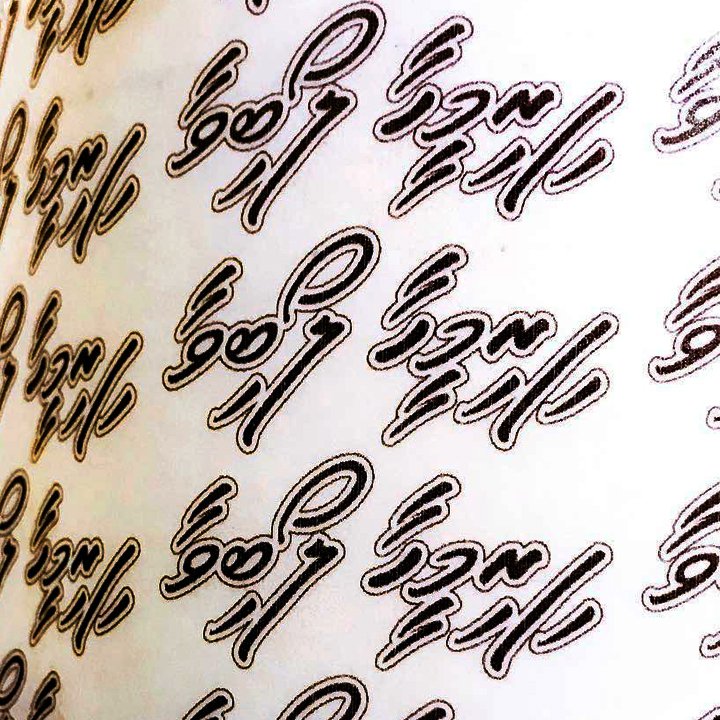
 Dhives Akuru script used in official document, Male' 18th century. Photo: NCLHR Collection.
|
Dhives Akuru
Eveyla Akuru underwent many changes over the centuries and evolved into the later
form, now called Dhives Akuru or Dhivehi Akuru. Many features of Eveyla Akuru
were retained in Dhives Akuru. As in the earlier Eveyla Akuru, Dhives also had
vowels and consonants, and vowel strokes or fili. It was also written
from left to right, and consonant characters standing on their own had the inherent
a sound. Many modifications had been made to the shapes of letters and new symbols
had been incorporated into the Dhives alphabet, to represent new sounds.
In
the Dhives Akuru alphabet, the consonant symbols numbered forty-one and there
were fifteen symbols for vowels, including in some cases, more than one symbol
for the same vowel. In documentation written in Dhives Akuru, verses from the
Quran as well as all Arabic words, including Arabic names and words commonly used
in Dhivehi, were always written in the Arabic script. This often led to difficulties
since Dhives was written from left to right and Arabic from right to left. Very
beautiful examples of Dhives Akuru can be seen in the inscriptions on the walls
of the Hukuru Miskiy, on ancient tombstones carved from coral slabs, and in some
finely written official land grants, inscribed on wood or parchment.
This script was used extensively for all official purposes until the end of the
17th century and the beginning of the 18th century. A few copperplates written
in later years have been written in this script.
Thaana
Akuru Thaana is a system of writing developed to meet the
needs of the Dhivehi language. Although the influence of Arabic and Persian can
be seen clearly, vestiges of the early Dhives Akuru writing system can still be
found in its basic rules (Mohamed 1999:39).
Early Dhivehi scripts were
written in the left to right direction, unlike scripts used in many Islamic countries.
Arabic, Persian and Urdu, languages used by Muslims in the Middle East and India,
were written from right to left. The late 16th to the 18th centuries was a period
when trade was well-established between Maldives and other countries, and Maldivians
were in constant contact with people from these countries. Trading ships came
regularly to Maldives to buy cowries and other products, and learned Muslim teachers
often arrived on these vessels. By the 15th and 16th centuries, Maldivians too
were travelling to Arabia for religious studies and some of them were well-versed
in Arabic. The religious awareness of the time, and a desire to belong to the
community of other Islamic nations, may have been one of the chief reasons for
the change to Thaana.
Wilmott Christopher who stayed in Male' from
4th June to 9th September 1835 AD, writing in his memoirs of his visit to the
Maldives, spoke of the scripts then in use. He writes thus of Thaana, which was
in extensive use at that time: 'The modem alphabet contains eighteen letters,
and is called by the natives Gabuli-Tana (early Thaana). There are some auxiliary
letters in it, derived from the Arabic and Persian, in common use but not included
in the alphabet. It is written from the right hand, and was introduced when the
Portuguese garrison were overcome and Mahomedanism (Islam) reestablished by a
chief and men from the Northern Atolls, and is now used throughout the islands.'
The
chief and men from the Northern atolls referred to in this context were Muhammad
Thakurufaanu and his companions from Utheem in Thiladhummathi. This is the story
told in oral tradition, which says that Thaana was introduced to Male' by Muhammad
Thakurufaanu.
There are different theories about the origin of the
name Thaana. Since many Dhivehi words have their origins in old Sanskrit and a
few in old Indonesian as well as some other languages, one of the following derivations
might be possible: Tana (Sanskrit), meaning offspring or posterity; Tanah(
Indonesian), meaning land or country; Than (Dhivehi), meaning place.
Thaana
Akuru would then mean 'script of the country', or 'script of the people'.
The
Thaana alphabet consists of twenty-four letters, the first nine of which are derived
from the first nine Arabic numerals, and the next nine from a set of old Dhivehi
numerals (Salahuddin, 1928). The last six letters of the alphabet are adaptations
of existing letters to accommodate the remaining sounds. In early Thaana, the
term viyani was also used to indicate the letters of the alphabet.
In
the mid-twentieth century, more letters were added to this original alphabet,
to enable the phonologically correct writing of names and loan words. mostly from
Arabic. These were formed using a system of placing dots on individual letters.
Unlike
the earlier Dhivehi scripts, the Thaana script is written from right to left.
On examination of early Thaana documents, it seems probable that the existing
Thaana script of the 17th century was modified for official use during the early
18th century. Early Thaana writing shows a strong Arabic influence in the use
of vowel strokes and in the shapes of individual letters. The script shows a radical
change in the form of the letters, and the system of Dhivehi writing. This script
did not evolve from Dhives or Eveyla Akuru, but was developed from other existing
sources to fit the needs of the Dhivehi language. It does not have the inherent
a sound as in Eveyla and Dhives Akuru, and is written from right to left
unlike the earlier scripts, showing the Arabic and Persian influence of the post-Islamic
era.
It can be clearly seen that some of the characteristics of Arabic
writing had been modified, indicating that the creators of this system of writing
were well versed in Arabic as well as Dhivehi. Early Thaana was known as Gabulhi
Thaana. In Dhivehi, the word gabulhi was frequently used as a derogatory term
to indicate incompleteness, or a lack of finish. Thus it can be conjectured that
the gabulhi here refers to the incomplete stage of the script, taking the term
from the Dhivehi word for the in-between stage of the coconut, when it is neither
the ripe nut nor quite tender, meaning that it is not fully developed.
Early
in the 20th century, the script became known simply as Thaana. From the early
years of the 18th century until about 1780 AD, Dhives and Thaana Akuru were both
used for official documentation, but at the end of this period, Dhives Akuru was
superseded by Thaana.
At the time of Christopher's arrival in Male'
in 1835, Dhives Akuru had been almost forgotten in Male'; only a few individuals
were able to write the script, but it was still in use in the Southern atolls.
Pyrard
de Laval's Observations Pyrard de Laval and his companions
were shipwrecked in Maldives on 2nd July 1602. following which Pyrard spent about
seven years in Maldives, until his departure in February 1609. During this time,
he made a number of observations on the people, their culture and the country.
He
observed that there were three scripts in use in Maldives at that time. Among
the observations he made was the following: 'Their letters are of three sorts:
the Arabic, with some letters and points which they have been added to express
their language; another, whose characters are peculiar to the Maldivian language;
and a third, which is common to Ceylon and to the greater part of India.'
Pyrard's eyewitness account proves that three scripts were in use at the time.
The first of these, 'the Arabic, with some points added to express their language',
is clearly the script known to Maldivians as Hedhi Akuru, a less common script,
which used the Arabic alphabet and had additional letters included, to express
sounds not present in that alphabet. These additional letters were formed by placing
a dot (point) or dots at different positions on particular letters. This script
was used mainly to write names, and continued to be used until the 20th century.
The
second script, which Pyrard says is peculiar to the Maldivian language, could
only be the very early Thaana Akuru. This is the script that eventually superseded
Dhives Akuru in the late 18th century. The earliest records of Thaana found so
far date from 1705 AD. According to oral tradition, the Thaana script was introduced
by the national hero Muhammad Thakurufaan in the 16th century. Pyrard's account
shows that this script was in use at the beginning of the 17th century, suggesting
that oral tradition may be correct in saying that Thaana was in fact introduced
by Muhammad Thakurufaan. His son Ibrahim III (Kalaafaanu), was the reigning sultan
at the time of Pyrard's stay in Maldives.
The third script referred
to by Pyrard as, 'common to Ceylon and the greater part of India', must be the
Dhives Akuru script which was in common use during the 16th and 17th centuries.
This script has a marked resemblance to the Malayalam script of South West India,
and also to the Sinhalese script of Ceylon (Sri Lanka); therefore, it is quite
possible that Pyrard made the mistake of thinking that they were the same.
Conclusion
If civilization is to be measured by the time when writing started in a culture,
Maldivians had achieved this almost one and a half thousand years ago, the earliest
existing inscription being dated to the 6th century AD. The evidence from the
following centuries show experiments at different stages in the evolution of a
script that became part of the nation's identity. This script Eveyla Akuru was
further developed with additional letters to facilitate the writing of the new
sounds in words that were constantly being introduced into Dhivehi. The script
eventually became the elegant Dhives Akuru.
In later years, when it
became necessary to break with the old traditional way of writing, the learned
Dhivehi scholars formed a totally new alphabet that suited the demands of the
time and was capable of adaptation. Modern Thaana has changed considerably from
its early style. The rules of writing have been modified to meet changing needs,
and may have to evolve still further, to accommodate future demands of the Information
Technology age.
References Al-Hussaini,
Hussain ibn Mohamed (BodufenvalhugeSeedi) 1959. Dhivehi Akuru. Male'. Bell.
H. C. P. 1940. The Maldive Islands: Monograph on the History, Archeology and
Epigraphy. Colombo. Christopher. W. 1836-38. Transactions of the
Bombay Geographical Society. Vol. I. Bombay. Gippert, J. 2003. A Glimpse
into the Buddhistic Past of the Maldives, I: An early Prakrit Inscription. (Unpublished
essay). Mohamed,N. 1999. Dhivehi Writing Systems, Male'.
Mohamed, N. and Ragupathy P. 2005.Inscriptions of Maldives No. I. Male'.
Najib, A. and A. Shafeeq 1993. Eveyla Akuru. Male'. Pyrard, F.
1887-1889. edited and translated by Albert Gray assisted by H.C.P. Bell. 1887-1889,The
Voyage of Francois Pyrard of Laval to the East Indies, the Maldives, the Moluccas
and Brazil. London. Ragupathy, P. 1994. The South Asian Heritage
of Early Maldives. Male'.
|
|
|