|
|
Marine investigations in the Lakshadweep Islands, India
Sila Tripati Antiquity 73, 1999 pp.827-35
The Lakshadweep
Islands lie on the sea route between west Asia and Africa on the one hand and
south Asia and the Far East on the other. In maritime history, these islands
have played a vital role by providing shelter, fresh water and landmarks to
navigators through the ages. Recent discoveries made during marine archaeological
exploration and excavations in the Lakshadweep have revealed evidences of early
settlement and shipwrecks. The findings suggest that the islands had been inhabited
much before the early historical period.
Introduction
India, one of the oldest maritime nations of the world, has been maintaining
commercial and cultural contacts with African. Arabian and Southeast Asian countries
for the last 5000 years. The findings of excavations at various coastal sites
of India have provided convincing evidence of such relations.
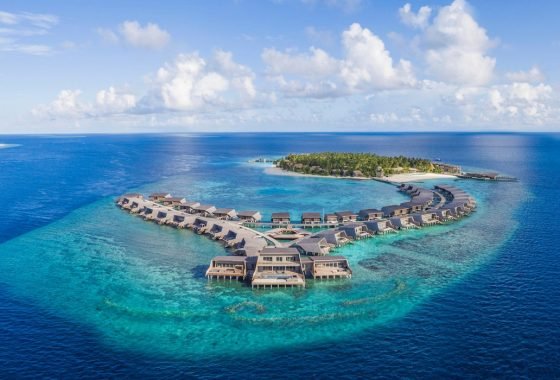
The group of 36 islands scattered off the southwest coast of
India between latitudes 8 degrees and 12 degrees 37 minutes N, and longitudes
71 degrees and 74 degrees E are known as the Lakshadweep (Laccadives). The word
laksha is derived from the root lag, meaning a mark or sign. In addition
to these islands, there are a number of submerged banks, open reefs and sand banks
in this region. Only 11 of these islands are inhabited: while the rest are small
and serve as satellites of the inhabited islands.
Minicoy is the southernmost
island of this group, separated from the rest by the Nine Degree Channel. Kavaratti,
Kalpeni. Androth and Agatti form the southern group while Amini, Kadmat, Kiltan,
Chetlat and Bitra make up the northern group of islands of Lakshadweep. All the
islands are generally oriented north-south except Androth which lies east-west.
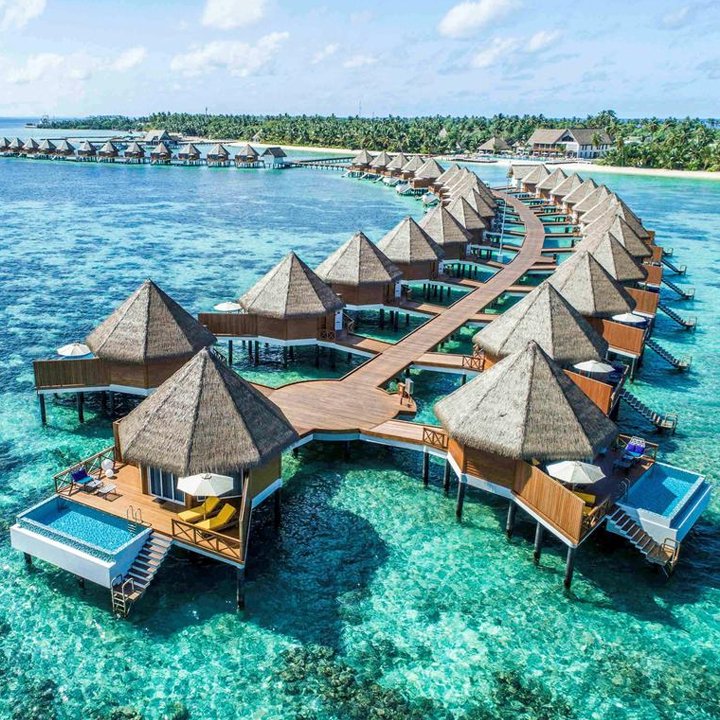
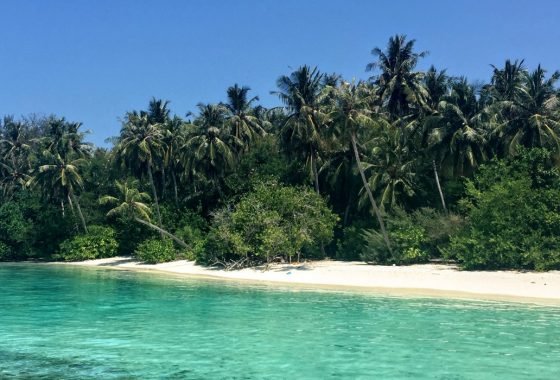
These
islands are famous for their beautiful lagoons, colourful coral reefs and clean
coralline beaches. Most of them are enclosed by lagoons with coral reefs on the
western sides, protecting them from the fury of the monsoon. The lagoons are 0.5
- 1.5 km long with a maximum water depth of 10 m.
Earlier these islands
were known as Divis or Dibajat which means islands. The islanders identify themselves
as Divis even today. The Lakshadweep Islands lie on the sea route between west
Asia and north Africa on one side, and south Asia and the Far East on the other.
These islands have been known to navigators of various countries and served as
good landmarks for sailors, places for refuge in case of mishap and for replenishment
of fresh water etc. Therefore, ancient seafarers of India as well as other countries
might have taken shelter on the Lakshadweep, particularly in case of emergency.
The
early settlers were people from Gujarat, Kerala and Tamil Nadu. These people were
engaged in maritime trade between the mainland of India and the Arab and African
countries, as well as with the western world. Country craft called Odams and Bandodies
provided the only means of communication between the islands and mainland (Bhatt
1997). Such seafarers might also have crossed to other islands, namely the Maldives
and the Andaman and Nicobar group of islands on their way to the far eastern countries.
Geology & geomorphology of the Lakshadweep Islands Geologically
these islands are a part of the Indian subcontinent and wore separated due to
faulting of the ridge 53—54 million years ago. The rock stratum is a continuation
of the Aravalli hills of Rajasthan (Mannadiar 1977). The Lakshadweep Islands do
not show any major topographic features and are mostly low and flat-topped with
a height of less than 6 m above sea-level. Most of the islands are long and irregularly
shaped. They are believed to have been formed as the result of coral growth.
The
soil is porous, and lakes, rivers or streams are completely absent. Drinking-water
is drawn from wells and tanks on the inhabited islands. The water is hard and
a little brackish in some places.
The eastern seaward shores of all
the islands except Kadmat, Agatti, Bangaram and Cheriyakara are marked by rough
waters. The eastern shelf of the islands rises precipitously from the sea enabling
ships to get very close to the islands (Athawale 1991).
Objectives This
paper aims to synthesize the information available from earlier explorations and
excavations in the Lakshadweep including the work carried out by the National
Institute of Oceanography (Vora 1994; Gaur et al. 1998). The objectives of these
explorations have been to locate archaeological sites on land and collect data
for reconstructing cultural contacts, to trace the trade links of these islands
with the mainland, and to locate shipwrecks in Lakshadweep waters.
Historical
evidence These islands were known to the sailors of various
countries since the early historical period. The earliest reference to these islands
is made in the Periplus of the Erythraean Sea, by an anonymous author of the 1st
century AD, who refers to the islands off Damirica (the name assigned to Malabar
at that time), in connection with the export of tortoise shell (Casson 1989; Schoff
1974).
Another early reference is by Ptolemy (150 AD), who states that
opposite Taprobane (Sri Lanka) lies a multitude of islands said to number 1378
(McCrindle 1885). H.C.P. Bell (Gabriel 1989) identified the names of some of the
islands mentioned by Ptolemy, e.g. Kanathra=Kavaratti, Argidion=Agatti, Ammine=Amini,
and Monache=Minicoy.
Historians such as Ammianus Marcellanus (320-390
AD), Fa-Hien (5th century AD), Cosmas (535-550 AD), El Masudi (916 AD) and Ibn
Batuta (1343-44 AD) have also referred to these islands and the Maldives (Pyrard
1888:426-34).
A hoard of more than 400 Roman coins of 119-138 AD was
found at Kadmat (Turner 1989) and also reported from Androth (Mohandas 1951).
The finding of these coins shows that during the early centuries of the Christian
era, the Romans had trade contacts with the Lakshadweep islands. The islands were
also referred in Buddhist Jataka stories and inscriptions.
Some indirect
references to naval wars also come from the Vayalur inscriptions near Mahabalipuram
in Tamil Nadu, such as the one which mentions that Narasimha Varman II Rajasimha
(680-720 AD) of the Pallava dynasty conquered the Lakshadweep Islands (Sastri
1925-26). The inscription reads: May he exercise the royal prerogative and take
up the vow of administering (his) subjects up to the extremities of his kingdom,
as even to include the Dvipalaksham (thousands of islands).
The Narendra
inscription of Shashthadeva, the Kadamba king of Goa, states that he had conquered
Kavadi dvipa, which seems to correspond to Kavaratti, the capital of Lakshadweep
(Rao 1994). Similarly, the inscription from the Rajarajeswar temple of Tanjavur
mentions that Rajendra Chola (1018-19 AD) conquered many islands including the
Lakshadweep (Mannadiar 1977). These naval wars reflect the importance of the Lakshadweep
at that time.
The 11th-century AD Sanskrit text Mooshakavamsa also
refers to the annexation of these islands by the king of Vallabha (Rao 1916).
Archaeological
background and onshore explorations Human settlement in
the Lakshadweep is believed to have taken place around 1500 BC because the ancient
ports of the west coast of India were exporting Indian merchandise to East Africa
and other countries. Excavations at Lothal in Gujarat have revealed the presence
of terracotta gorillas revealing Indian sailors' links with the East African coast
(Rao 1973). Recent excavations at Kalpeni have yielded terracotta objects dating
back to 1500 BC supporting the hypothesis that these islands were occupied from
1500 BC, if not earlier (Saigal 1990).
Onshore explorations were carried
out at islands of potential archaeological and historical importance, in order
to establish the time frame and correlation with history. Onshore explorations
at Kavaratti, Androth, Agatti and Amini unearthed red ware, dull red ware, buff
ware and Red Polished Ware (RPW) (Rao et al. 1995-96).
The scraping
near the Ujira Habibullah Mosque mound of Kavaratti brought to light a number
of potsherds; the majority of them belong to red ware and a few are dull red ware
and black ware (FIGURE 2 below).
Large quantities of red ware, dull red ware and a few black
ware were also found in the habitational mound of Androth (FIGURE 3 below). All
potsherds collected from Kavaratti and Androth are small and the main shapes are
pots and small jars, rendering it difficult for identification of any incised
designs and paintings. Probably painting might have been destroyed due to the
marine environment.
The collection mainly includes rims of different types, namely
grooved, splayed-out rims, squarish grooved etc. Interestingly, no bases or other
parts of pottery were found during the exploration. The pottery is mostly ill-fired
and the fabric is medium to coarse and medium to thin in section. These are wheel-made,
and striation marks are visible in the interior. Most pot-sherds have pitting
marks. Only one shred of glazed ware with blue designs was found at Kavaratti.
No glazed wares were found in Androth.
Earlier exploration by the Archaeological
Survey of India (ASI) had revealed two phases of occupation in a section having
a gap with sand deposit and an ancient structure at the top (FIGURE 4 below) (ASI
1983-84).
At another place on Androth potsherds were found
at different levels, the lowest lying at a depth of 2.5 m just above the coral
sand, indicating that the island was occupied after the coral formations had been
exposed for some time. Detailed examination of this section revealed evidence
of three other levels of human occupation (FIGURE 5 below).
The occupational levels yielded potsherds, black ashy deposits
and fragments of animal bones (A.K. Sharma pers. comm.). Locally the mounds are
known as 'Kalikatta' and 'Kunthathupalli'. Medieval pottery was found in the Jama
Mosque. Mazar and Waliullah Mazar area of Agatti. It is however reported that
some sculptures of earlier period were also found in this island. A trench which
was being excavated for the foundations of a public building was examined at Amini
where red ware and coarse grey ware of early historical and medieval periods were
noticed (Rao et al. 1995-96). The occurrence of a small tank in the presently
uninhabited island of Cheriyam reveals that it was inhabited during earlier times.
Besides coins and pottery a coral block with a demon face, protruding canine and
tongue was also found in Androth. Similarly, a granite piece was found from a
house in Kalpeni on which a headless female figure was carved in low relief, with
folded hands and standing on a makara. On the left side of the figure, a tofa-shaped
pot and on the right side a 'T'-like object, probably the wooden handle of a ploughshare,
have been depicted. The figure appears to be that of goddess Ganga (A.K. Sharma
pers. comm.).
Similarly, red-ware sherds, celadon and glazed ware were
also collected during explorations at Kurumathi, Landu and Kudahuvadu islands
of Maldives by ASI (FIGURE 6 below).
The red-Ware sherds do not have any slip, wash or designs. The
main shapes are carinated bowls, jars, handis and lids. The striation marks on
the pottery suggest fast wheel-manufacturing technique (Gupta 1995). From the
potsherds found in the Buddhist establishments only one was glazed ware, whereas
the others were red ware and celadon ware. Potsherds of celadon and glazed ware
have floral decorations. The noteworthy finding was the Celadon ware bowl With
floral design on its lip.
Buddhism in
Lakshadweep The Buddhist Jataka stories of the 6th century
refer to the Lakshadweep and Maldives groups of islands. The ships which plied
between Bharukaccha in Gujarat and southeast Asian countries would cross the Lakshadweep
and Maldive islands and some of these might have been wrecked bv subsurface reefs.
However, very little is known about Buddhism in the Lakshadweep Islands. Recent
explorations have provided evidence of Buddhism in the islands.
The
evidence indicates that Buddhism reached Lakshadweep at an early date, probably
at the same time when Ashoka the Great sent his emissaries to Sri Lanka. Three
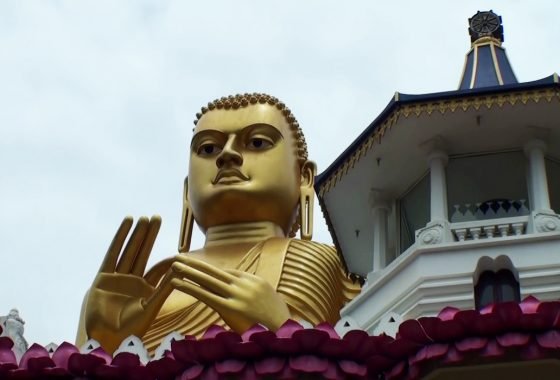
idols have been found in Androth island which are kept in the storeroom of the
Government high school. Of these, two are Buddha heads and one is Yaksha. The
larger of the Buddha heads is significant because its height, the facial expression
with half-closed eyes, long ears, curly hair and meditation posture indicate that
it belonged to the Gupta period 400-500 AD (FIGURE 7).
The height of the larger head is 100 cm and its circumference
is 116 cm; the smaller Buddha head weighs 70 kg, and its height and circumference
are 68 and 116 cm, respectively. The Yaksha-like figure with protruding canine
is about 125 cm high (FIGURE 8 below).
Some human sculptures carved out of coral slab were also noticed.
These heads were recovered from a huge mound called 'Perumpalli' in the southern
centre of the island while digging foundation-trenches for a school building.
Perumpalli means a great Vihar. Similarly, a Buddha head was also discovered during
the trial digging near the General Hospital in Kavaratti in 1971. This measures
40 cm in length and 30 cm in width. It seems that the torso was thrown into the
lagoon of the island. All these idols are much damaged and defaced, probably by
local people.
In Minicoy island also, similar Buddha heads were recovered
from the mound of Aludi and eastern shore of Sedivalu village (Sharma & Khan 1994).
Another Buddha head measuring 50 cm in height and 35 cm in width was recovered
from a mound of Minicoy. The socket at the back is meant for attachment to the
torso. These heads are much damaged and facial features are disfigured due to
flaking of the plaster. The idols are made of coral rocks. The coral blocks were
first shaped like a human head and the plastered with coral paste and the details
carve The curly hair, broad forehead and ears clearly visible but the facial portions
have been damaged.
The explorations by ASI have yielded a large number
of Buddhist remains such as stupa monasteries, water tanks and enclosure wall
at Kuramathi, Kudahuvadu. Toddu, Landu Nilandu North and Ariadu in the Maldives.
All these are now in ruined condition and mosques and houses have been constructed
on these remains. Beads of semi-precious stones, ornaments of gold and silver
and terracotta figurines etc. were found in a relic chamber of stone at a Buddhist
complex of Kuramathi (ASI 1986-87).
Discussion Since
the people of the Lakshadweep Islands do not have any aboriginal groups, scholars
had postulated different views about the history of habitation on these islands.
Now it is clear from archaeological research that settlement started in these
islands before the early historical period. Onshore explorations at Kavaratti,
Agatti, Androth and Amini revealed that the earliest settlement probably took
place between Pre-Christian period and the 5th century AD, as is evident from
the RPW, red ware, dull red ware and red and black ware.
The pottery
mainly found at Androth, Kavaratti, Amini, Agatti and Kalpeni were probably imported
from the mainland. As there is no availability of clay in these islands and all
pottery was probably imported, all pottery found in these islands is similar in
fabric and typology. No datable antiquities have been found along with pottery
during our exploration in these islands.
The RPW is recognized as one
of the most important ceramic products of the early historical period of India
datable to the early Christian era till the 5th century AD. Fragments of RPW are
reported from a number of sites in India. This ware is made of well-levigated
clay and a thick red slip is polished on this ware. Due to firing at a high temperature
these vessels are sturdy and produce a metallic sound. The colour varies from
dark red to pink. The main shapes are sprinkler and Surahi which is widely
distributed, and the other types are jars with grooved rim. flaring neck, bulbous
body and ring-footed base. The bowls have incurved, beaded and thick rims, carinated
shoulders and convex sides. The earlier impression of the archaeologists was that
the RPW was imported or could be an imitation of the Roman Samian ware. From its
wide distribution in various types, it is considered to have been indigenous during
Pre-Christian era.
The occurrence of pottery in Lakshadweep and the
Maldives is significant as there is no clay for manufacture and hence it might
have come either from India or Sri Lanka. The Buddha heads at Androth, Minicoy
and Kavaratti suggest that Buddhism prevailed in those islands since the 5th-6th
centuries AD or earlier. The style of these figures resembles those of a particular
period of the mainland Buddhist centre. The figures are made out of local coral
rock. Presently these Buddhist antiquities are lying in public buildings, in bad
condition and in need of urgent attention and preservation. The antiquities and
Buddhist relics which were found during exploration and excavation in the Maldives
are now kept in National Museum at Male'.
Conclusions
The discovery of Buddha heads and other antiquities clearly indicates that Buddhism
prevailed in the Lakshadweep Islands during the 5th-6th centuries AD. As the Lakshadweep
Islands lie on the trade route, settlement on these islands is expected to be
much older, but those may have been temporary settlements.
To unearth
the past history of Lakshadweep, and to verify the findings of Saigal (1990),
it is essential that archaeological excavation should be undertaken at least at
Kavaratti, Androth and Minicoy islands. If the findings are correct then the history
of settlement of Lakshadweep would be much older than the early historical period.
Further,
in-depth explorations should also be carried out at other islands where Buddhist
remains have not been reported; the results of exploration may bring some other
new evidence on the archaeology and history of Lakshadweep.
Acknowledgements:
The author is grateful to the Director (NIO) and Shri. K.H. Vora. Scientist-in-Charge,
for granting permission to publish this paper, also to Drs M.C. Joshi and A.K.
Sharma for providing information on Lakshadweep. Thanks are also due to all the
colleagues of MAC for their participation in the cruise and collection of data.
The author also thanks Shri. S.B. Chitari for drawings and Shri. S.N. Bandodker
and Shri. Sheikh Ali for photographs.
References
ASI, 1983-84. Indian Archaeology 1983-84 - A review. New-Delhi:
Archaeological Survey of India. 1986-87. Indian Archaeology 1986-87
- A review. New Delhi: Archaeological Survey of India. ATHAWALE, S.
1991. India's Indian Ocean islands. New Delhi: ABC Publishing House. BHATT,
S.C. (ed.). 1997. The Encyclopaedic District Gazetterrs of India 2. New
Delhi: Gyan Publishing House. CASSON, L. 1989. The Periplus Maris Erythraei.
English and Greek text with Introduction, translation, and commentary. Princeton
(NJ): Princeton University Press. GABRIEL, P.C.T. 1989. Lakshadweep —
history, religion and society. New Delhi: Books & Books. GAUR, A.S.,
K.H. VORA, SUNDARESH, S. TRIPATI. P. GUDIGAR & S.N. BANDODKAR. 1998. Exploration
of steam engine wrecks off Minicoy Island. Lakshadweep. India. International
Journal of Nautical Archaeology 27/3: 225-36. GUPTA. S.S. 1995. Buddhist
remains'in Maldives. Puratattva 25: 77-80. New Delhi: Indian Archaeological
Society. McCRINDLE. J.W. 1885 [1985]. Ancient India as described by Ptolemy.
New Delhi: Today & Tomorrow's Printer & Publishers. MANNADIAR, N.S. (ed.).
1977. Gazetteer of India - Lakshadweep. Coimbatore: Government of India
Press. MOHANDAS. P.N. 1951. Our numismatic collection, in Madras Central
Government Centenary Souvenir 1851-1951. Madras. Pyrard. F. 1888. The
voyage of Francois Pyrard of Laval to the East Indies, the Maldives, the Moluccas
and Brazil 2(1). (Tr. Albert Gray.) London: Hakluyt Society. First series
no. 77. RAO, S.R. 1973. Lothal and the Indus civilization. New
York (NY): Asia Publishing House. 1994a. Marine archaeological exploration
of Byramgore reef of Lakshadweep in the Indian Ocean, in Rao (1994b): 67-9. (Ed.).
1994b. Role of Universities and Research Institutes in Marine Archaeology.
Goa: National Institute of Oceanography. RAO. S.R.. K.H. VORA. A.S. GAUR.
P. GUDIGAR. SUNDARESH & S. TRIPATI. 1995-96. A preliminary shipwreck exploration
off Lakshadweep. Journal of Marine Archaeology 5-6: 23—31. RAO.
T.G, 1916. Tranvancore Archaeological series 2. Tranvancore. SAIGAL.
O. 1990. Lakshadweep. New Delhi: National Book Trust. SASTRI. H.K.
1925-26 [1983]. The Vayalur inscription of Rajasimha II. Epigraphia Indica
18: 145-52. New Delhi: Archaeological Survey of India. SCHOFF. W.H. 1974.
The Periplus of the Erythraean Sea: Travel and trade in the Indian Ocean by
a merchant of the first century. New Delhi: Oriental Books Reprint Corporation.
SHARMA. A.K. & M.F. KHAN. 1994. Buddha heads and some grave head stones from Lakshadweep,
in Rao (1994b): 129-31. TURNER. P.J. 1989. Roman coins from India.
London: Institute of Archaeology. Occasional publication 12. VORA. K.H. 1994.
Marine archaeological explorations in Lakshadweep waters. Technical Report
NIO/TR-9/94: 1-27. Goa: National Institute of Oceanography.
|
|